
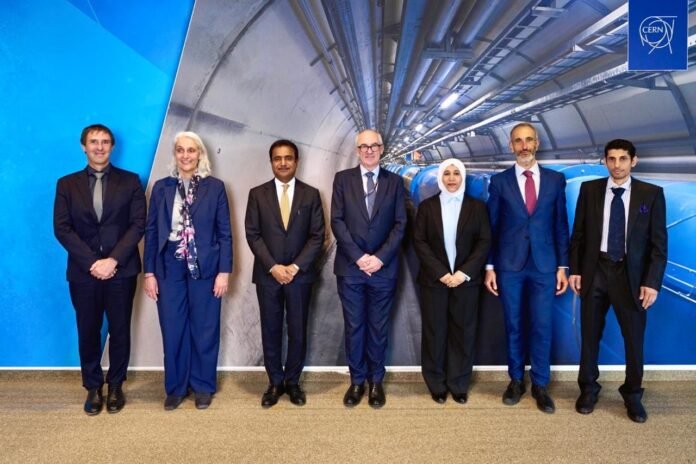
The Sultanate of Oman has signed a scientific and technical cooperation agreement with the European Organization for Nuclear Research (CERN), marking a step toward deeper engagement in global scientific research and innovation.
The agreement was signed in Geneva at CERN headquarters, with Oman represented by Ambassador Mahmoud Hamad Al Hasani, Ambassador to the Swiss Confederation, while CERN was represented by Director-General Professor Mark Thomson.
The cooperation framework focuses on high-energy physics and related fields, including accelerator engineering, computing, artificial intelligence, information security, and advanced materials science. It also provides opportunities for Omani scientists, engineers, and students to participate in CERN’s research and training programmes, alongside the exchange of expertise, personnel, and equipment.
Officials said the deal reflects Oman’s broader strategy to strengthen its knowledge-based economy and expand international scientific partnerships. It also establishes mechanisms for future cooperation between Omani academic and research institutions and CERN through specialised protocols and joint projects.
The agreement is set to last five years and will automatically renew, ensuring continuity in collaboration. It comes as CERN continues to work with multiple non-member states, supporting global participation in frontier scientific research.
For Gulf states, such partnerships are increasingly seen as pathways to diversify economies and build advanced technical capacity, particularly in fields linked to artificial intelligence, data science, and high-energy physics.
