
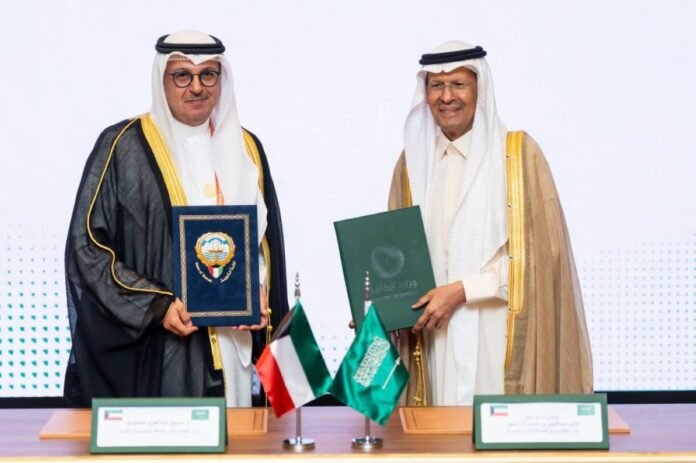
Kuwait and Saudi Arabia have signed an agreement to expand Energy Cooperation, focusing on electricity systems, renewable power and advanced technologies. The memorandum of understanding (MoU) aims to strengthen bilateral relations while creating new opportunities for joint development. Both countries intend to combine their expertise to improve energy infrastructure, enhance efficiency and support long-term sustainability.
The two governments signed the agreement in Riyadh on Sunday, October 11. Kuwait’s Minister of Electricity, Water and Renewable Energy, Dr Subaih Al-Mukhaizeem, signed alongside Saudi Energy Minister Prince Abdulaziz bin Salman. Their agreement establishes a framework for collaboration across several areas of the energy sector. Furthermore, it reflects both governments’ interest in developing practical partnerships that support national priorities and future economic needs.
Al-Mukhaizeem described the memorandum as a significant development in the longstanding relationship between Kuwait and Saudi Arabia. He said the agreement opens a new phase of cooperation that could benefit both countries. Moreover, he highlighted the potential to combine national capabilities, exchange technical knowledge and introduce modern solutions. These efforts, he explained, could improve energy systems while supporting more sustainable operations.
The Kuwaiti minister also emphasized the importance of turning the agreement into practical programs and shared initiatives. In particular, he pointed to developing national expertise, transferring knowledge and encouraging technology localization. These priorities could help strengthen energy security while meeting growing development needs. He also stressed the importance of preparing future generations to manage evolving energy demands.
The memorandum covers renewable energy, electricity grid interconnection, energy storage and smart grid development. Through these areas, both countries can explore ways to improve infrastructure and increase operational reliability. Additionally, the agreement provides opportunities to strengthen electricity exchanges and exports between the two national systems. Cooperation could also support more efficient energy use and help integrate renewable sources into existing networks.
Energy Cooperation also includes research, innovation and digital transformation across the electricity sector. The two countries intend to explore technologies that modernize infrastructure and improve operational performance. Meanwhile, training programs and exchanges between specialists could help develop a skilled national workforce. Universities and research centers may also participate through joint studies, technical exchanges and collaborative projects.
The agreement further addresses technologies designed to mitigate climate change. These include applications associated with the circular carbon economy, alongside broader innovation and digital development. Both countries also plan to strengthen cybersecurity within energy infrastructure as digital systems become increasingly important. Consequently, cooperation could support more resilient networks while helping protect essential services and operational information.
Another area involves partnerships between specialized companies in Kuwait and Saudi Arabia. The memorandum encourages cooperation to localize materials, products and services while developing related supply chains. In addition, both sides can organize specialized visits, conferences, workshops and training activities. These exchanges would provide opportunities to share information, compare experience and identify practical solutions to common challenges.
Al-Mukhaizeem thanked Prince Abdulaziz for his role in preparing the agreement and reaffirmed Kuwait’s commitment to continued coordination. He emphasized the need to activate the memorandum’s provisions and pursue measurable outcomes. Overall, Energy Cooperation offers both countries a framework for strengthening electricity infrastructure, advancing renewable technologies and supporting more reliable, sustainable energy systems.