
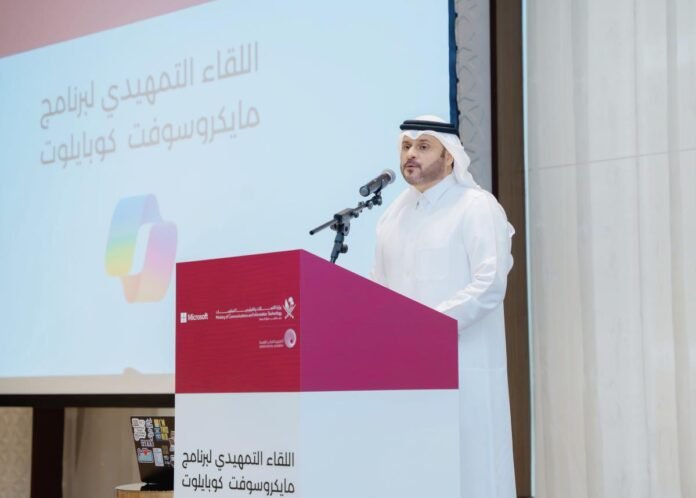
Qatar is assessing progress in Copilot Adoption across public institutions as authorities work to strengthen artificial intelligence use and government efficiency. The Ministry of Communications and Information Technology (MCIT) and Microsoft recently reviewed the programme’s second cohort, involving 17 government and semi-government entities.
The preparatory meeting brought together institutional leaders and representatives to examine implementation results, employee training, and practical applications. Organised through Qatar Digital Academy, the initiative aims to help public sector employees integrate Microsoft 365 Copilot into their daily responsibilities. Consequently, the discussions focused on achievements so far and priorities for the programme’s next stage.
Sami Mohammed Al Shammari, MCIT’s Assistant Undersecretary for Infrastructure and Operations Affairs, opened the meeting with a welcome address. Participants then reviewed usage figures, training progress, and developments in artificial intelligence agent applications. They also discussed experiences from participating institutions and identified opportunities to expand effective applications across government operations.
The figures presented showed more than 8,000 active users among 12,260 licensed users, representing an adoption rate of 69.6%. In addition, participating entities recorded approximately 2.1 million actions and tasks through the tool. These results indicate growing engagement while providing authorities with measurable indicators for assessing its practical value.
Training remained another major focus, with the programme delivering 508 sessions to more than 9,000 employees. These activities included introductory instruction, executive leadership sessions, workshops identifying potential applications, and specialised skills development. Furthermore, dedicated teams received support to help institutions maintain implementation and encourage employees to use the technology effectively.
The meeting also examined 96 artificial intelligence agent use cases developed under the initiative. Practical demonstrations explored ways to improve workflows, strengthen access to institutional knowledge, and address operational needs. As a result, participants considered how organisations could move beyond individual experimentation towards applications supporting wider institutional priorities.
During an executive discussion, representatives shared successful experiences and outlined challenges affecting broader implementation. They also considered how leadership support could sustain employee engagement and help institutions expand applications with greater practical value. Meanwhile, participants stressed the importance of connecting technology use to measurable outcomes and improvements in workplace processes.
Al Shammari highlighted the progress achieved and the importance of continued cooperation with Microsoft. He also emphasised leadership’s role in supporting employees, sharing successful practices, and evaluating improvements in work quality and operational efficiency. Looking ahead, MCIT intends to encourage wider use and develop applications that deliver stronger institutional benefits.
However, the discussions also underlined safeguards required for responsible artificial intelligence use. Participants addressed data protection, output verification, appropriate permissions management, and clear human accountability. These measures remain important as public institutions introduce AI tools into everyday processes and handle sensitive institutional information.
The review forms part of Qatar’s broader efforts to develop digital capabilities and improve public sector performance. Through continued Copilot Adoption, authorities aim to expand practical AI applications while strengthening employee skills and institutional readiness. Ultimately, the programme seeks to support a more efficient government environment through responsible technology use and measurable improvements.