
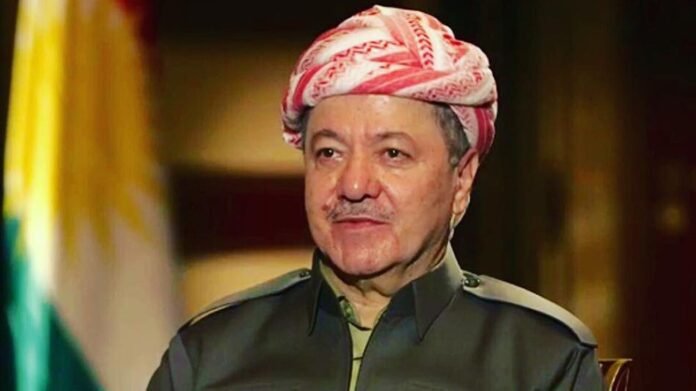
Masoud Barzani has pushed back against what he described as “incorrect interpretations” regarding the future and status of the Kurdish Peshmerga’s weapons, as Baghdad advances efforts to consolidate all armed forces under state authority.
In a statement posted on X late Wednesday, Barzani said that recent discussions surrounding the Peshmerga have led to “false opinions and misreadings” of their role and legitimacy.
“Some parties have been speaking about the Peshmerga’s arms and presenting incorrect interpretations and false opinions on the matter,” he said, without directly naming any officials or institutions.
He stressed that the Peshmerga is not merely a military force, but a symbol deeply tied to Kurdish history and identity.
“The Peshmerga was born from the blood, suffering, and tears of the people of Kurdistan,” Barzani said, adding that their weapons represent “history, sacrifice, dignity, and belief,” rather than just instruments of war.
His comments come at a time when the Iraqi federal government is intensifying efforts to regulate and unify armed forces under state command, including factions within the Popular Mobilization Forces (PMF).
Earlier, Prime Minister Ali al-Zaidi ordered the formation of a committee tasked with implementing measures to ensure that political factions and armed groups are brought under full state control, in line with constitutional provisions.
The PMF, established in 2014 during the fight against the Islamic State group, remains a powerful umbrella of armed factions, some of which are closely aligned with Iran-backed networks operating across the region.
Within the Kurdistan Region, however, officials insist that the Peshmerga operates under a separate legal and institutional framework.
Bakhtiyar Mohammed, secretary-general of the Kurdistan Regional Government’s Peshmerga Ministry, said there had been no official proposal to integrate the forces into Iraq’s federal security structure.
“If such a proposal is raised, it must first go through parliament and legal review,” he said, stressing that the matter “should be addressed through law, not through discussions and meetings.”
The remarks underline ongoing sensitivities between Erbil and Baghdad over security authority, amid wider debates on the future structure of armed forces in Iraq.
