
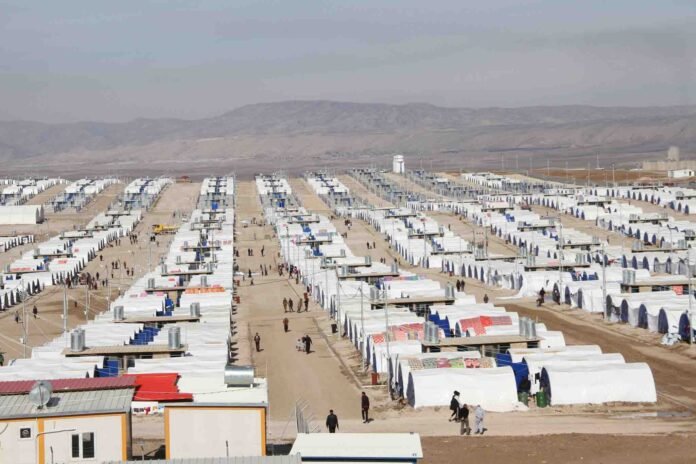
Aid to IDPs and refugees in the Kurdistan Region has dropped by nearly 80%. Officials in Duhok warn that the situation has reached alarming levels. They stress that the Iraqi Ministry of Immigration has failed to fulfill its duties.
Pir Dayan Jaafar, Director of the Migration and Displacement Department in Duhok, shared detailed figures. He explained that Duhok and Zakho host 20 camps. Fifteen camps shelter displaced persons, while five host refugees. Inside the camps, there are about 20,830 displaced families, totaling 110,000 people. Outside the camps, 35,000 displaced families live, adding up to 170,000 people.
Meanwhile, refugee numbers also remain high. Around 10,000 refugee families, more than 50,000 people, live inside the camps. Another 70,000 refugees reside outside the camps. Altogether, about 450,000 displaced persons and refugees live in Duhok and Zakho.
However, Jaafar highlighted a serious problem. Aid to IDPs and refugees has decreased by 80% in two years. He noted that humanitarian organizations and UN agencies have sharply reduced their support. As a result, the Kurdistan Regional Government now covers essential services. These services include health, water, education, electricity, and waste collection. The costs reach billions of dinars each month.
Furthermore, he criticized the Iraqi government for its unhelpful approach. He stressed that Baghdad has politicized the issue of displacement. For example, 14 out of 20 camps were built on farmland. Farmers have not received rent since 2017. The debts now total hundreds of billions of dinars. Landowners demand payment daily.
The Iraqi Ministry of Immigration has also failed to pay electricity bills for the camps. Food distribution is almost non-existent. Displaced families only received food baskets twice this year. Refugees have received no food assistance for two and a half years.
Jaafar also discussed return movements. Since the crisis began, around 10,000 families have gone back to their homes. Yet in the past two years, 800 families returned to camps due to insecurity, poor services, and no jobs.
At the same time, teams continue to issue national ID cards. They visit the camps every day and register 100 families daily. Thousands of displaced persons have already benefited from this process.
In conclusion, officials in Duhok continue to sound the alarm. Aid to IDPs and refugees remains dangerously low. They warn that without urgent action, the humanitarian crisis will worsen further.
