
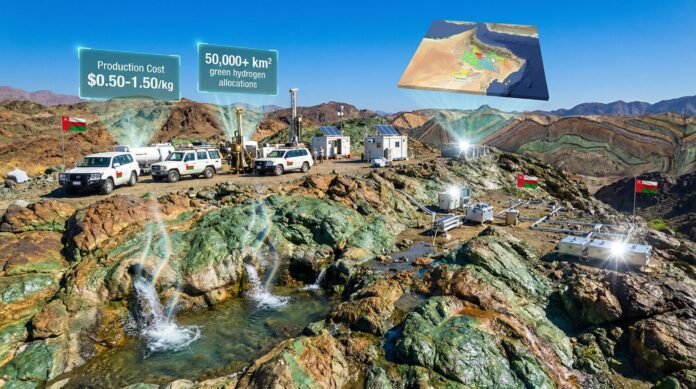
Oman natural hydrogen is attracting global attention as HyTerra signs an MOU to evaluate the country’s hydrogen resources. The partnership aims to assess technical, regulatory, and commercial pathways for potential development. Moreover, Oman natural hydrogen could help the country emerge as a major clean energy exporter.
HyTerra, an exploration company partially owned by Fortescue, will coordinate technical studies with ARA Natural Resources over an 18-month period. The collaboration focuses on evaluating prospective areas, analyzing geologic formations, and understanding permitting requirements. Experts believe these steps are crucial for unlocking Oman’s hydrogen potential.
Natural hydrogen, also called white hydrogen, forms naturally in the Earth’s crust. It accumulates over time through geological processes. HyTerra highlighted the Samail Ophiolite as a promising site, describing it as a “world-class” geologic hydrogen province. The formation contains ultramafic mantle rocks that generate hydrogen through serpentinization.
According to company officials, early exploration in Oman natural hydrogen fields could create significant value for both investors and the country. They emphasized the importance of disciplined evaluations, data-driven analysis, and careful risk management.
HyTerra has previously conducted test drillings in Kansas, USA, applying lessons that may guide exploration in Oman. The firm aims to combine geological expertise with modern extraction technologies. Although natural hydrogen remains a nascent energy sector, it offers the potential for low-carbon fuel production in the region.
Oman hopes to leverage its abundant natural gas and renewable energy resources to develop hydrogen economically. The government envisions hydrogen as part of a diversified energy portfolio, reducing carbon emissions and boosting global energy exports. However, technology for large-scale natural hydrogen extraction is still evolving, and research continues on feasible production methods.
Industry observers note that Oman natural hydrogen exploration could position the country as a pioneer in clean energy solutions. If successful, the projects could attract international investment, strengthen energy security, and enhance regional sustainability.
The MOU represents a strategic step toward establishing Oman as a competitive player in the emerging hydrogen economy. By combining geological potential, technological innovation, and regulatory planning, the country aims to unlock the benefits of clean energy for decades to come.