
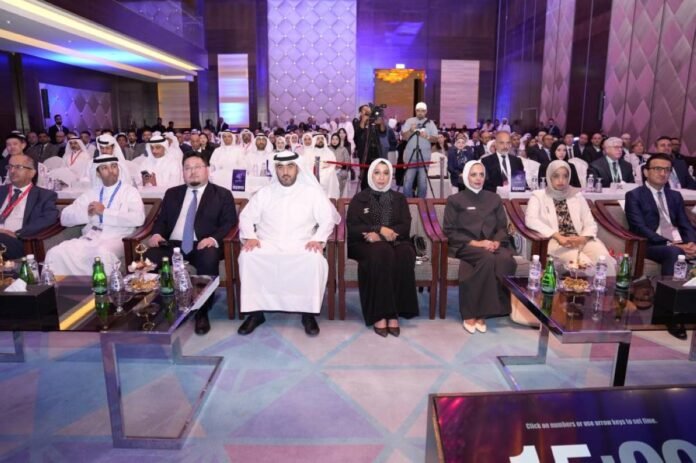
Government AI is driving Kuwait’s next stage of digital transformation, creating new opportunities to improve public services and institutional efficiency. However, officials also emphasise the need for stronger safeguards covering cybersecurity, data protection and responsible technology use.
Najat Ibrahim, Acting Director General of the Central Agency for Information Technology, outlined the progress on Monday. She spoke during the opening of the fifth Kuwait Digital Transformation Conference 2026.
The conference carries the theme “From Digital Transformation to a Smart Nation” and runs for two days. Organisers OM Events arranged the event with CAIT and the Communication and Information Technology Regulatory Authority.
Ibrahim reported progress under the government’s Microsoft Copilot initiative, which covers 79 government bodies. So far, 13 institutions have completed the adoption phase, while authorities have activated more than 40,000 licences.
Additionally, participating organisations have identified over 170 potential applications for the technology. These developments indicate a gradual move from experimenting with artificial intelligence towards practical workplace applications.
According to Ibrahim, these tools can help employees increase productivity and improve services for citizens and residents. Nevertheless, she stressed that technology ownership alone does not guarantee meaningful improvements.
She argued that institutions must turn digital investments into measurable, lasting benefits. In particular, government services should become easier to access, faster to complete and better connected.
Her remarks also highlighted the importance of developing digital skills across public institutions. CAIT training programmes reached 8,488 participants between January 2024 and August 2026.
Meanwhile, the agency continues developing infrastructure that supports Kuwait’s wider digital ambitions. Its work includes data centres, cloud computing systems and stronger cybersecurity capabilities.
These efforts also extend across several important sectors, including healthcare, education, finance and transportation. Furthermore, CAIT supports digital development in smart cities as Kuwait pursues its Vision 2035 objectives.
CITRA Deputy Chairman Manal Al-Mazeed also addressed the changing meaning of digital transformation. She explained that progress requires more than introducing new technology or transferring existing services online.
Instead, she described it as a broader institutional process connected to management performance and decision-making. She also highlighted effective regulation as essential for encouraging competition and protecting service users.
Regulators, she added, must monitor service quality while ensuring institutions remain accountable. Consequently, organisations should establish clear objectives before selecting artificial intelligence tools for specific tasks.
Al-Mazeed advised institutions to identify problems, expected results and acceptable risks before adopting AI solutions. She also warned that generative AI can produce convincing information without necessarily providing accurate answers.
Therefore, organisations must verify AI-generated material and protect sensitive information throughout their operations. She referred to the World Bank’s 2025 GovTech maturity data when discussing worldwide progress in public-sector digitisation.
Sheikh Mohammad Ahmad Al-Sabah, head of the Kuwait Artificial Intelligence of Things Association, called for deeper national integration. He said Kuwait needs connected institutions that exchange information securely, rather than simply increasing online services.
He also highlighted the growing influence of agentic AI, which can independently handle increasingly complex tasks. However, he stressed that organisations must establish clear accountability, governance standards and meaningful human supervision.
Sheikh Mohammad further warned employees about entering confidential government information into AI platforms. He urged staff to understand where their information travels and who can access it.
He noted that security and geopolitical concerns make sensitive infrastructure information particularly important to protect. Accordingly, employees should check platform access and data-handling practices before uploading official documents.
The conference also featured a panel examining ways to accelerate Kuwait’s digital transformation. In addition, an accompanying exhibition allowed technology companies to present their latest information and communication solutions.
Overall, Government AI remains central to Kuwait’s ambition to build a smarter public sector. Officials emphasised that responsible implementation, secure infrastructure and skilled employees will determine its long-term value.
