
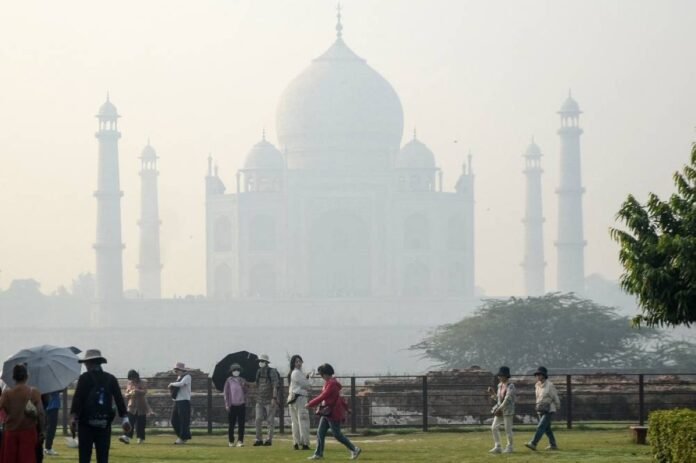
Delhi Air Pollution reached extreme levels during Diwali celebrations, overwhelming monitoring equipment across parts of the Indian capital. Authorities acknowledged that some instruments could not measure pollution concentrations beyond their maximum calibrated limits.
The admission followed accusations from opposition politicians, who questioned gaps in official air quality readings. Those gaps appeared overnight between Sunday and Monday, when fireworks celebrations caused pollution levels to surge.
New Delhi already faces serious air quality challenges during the winter months. Vehicle emissions, industrial activity and agricultural fires contribute to the thick smog affecting residents.
However, the missing measurements raised concerns about whether official records accurately reflected conditions during the worst pollution period. Opposition figures argued that authorities failed to provide a complete picture when residents needed reliable information.
Saurabh Bharadwaj, Delhi president of the Aam Aadmi Party, criticised the government in a video shared online. He questioned how citizens could trust official figures when monitoring stations appeared to stop recording during Diwali night.
Senior Congress lawmaker Ajay Maken also challenged the missing data. He asked who would take responsibility if authorities excluded the festival night’s highest PM2.5 readings.
The Central Pollution Control Board rejected suggestions that officials deliberately concealed pollution levels. Instead, the agency attributed the gaps to technical limitations affecting measurements during unusually severe pollution episodes.
Monitoring equipment reaches its limits
India introduced its National Air Quality Index in 2015, using particulate matter analysers to monitor pollution levels. Those instruments can measure concentrations reaching 1,000 micrograms per cubic metre.
However, the World Health Organization recommends a daily PM2.5 limit of just 15 micrograms per cubic metre. These fine particles can travel deep into the lungs and have links to cancer.
According to the pollution control board, automated systems exclude hourly readings that exceed calibrated measurement ranges. Consequently, extreme concentrations may appear as missing data rather than recorded pollution levels.
The agency explained that occasional events, including extensive Diwali fireworks, can produce these exceptional conditions. Therefore, monitoring stations may temporarily fail to provide usable readings during severe pollution episodes.
Although thick smoke covered city streets early Monday, the monitors captured the pollution peak only later. Reporting resumed around eight hours after fireworks activity reached its highest level.
A reading from Mandir Marg subsequently reached 879 micrograms per cubic metre. The figure represented more than 58 times the WHO’s recommended daily PM2.5 limit.
These figures highlighted the severity of Delhi Air Pollution after the celebrations. They also intensified questions about whether existing monitoring systems can accurately record increasingly extreme pollution events.
Congress lawmaker Pawan Khera argued that missing measurements did not mean the pollution had disappeared. He warned that residents continued breathing harmful smoke despite gaps in official records.
Khera also raised concerns about the potential consequences for public health and life expectancy. Meanwhile, the dispute has placed renewed attention on monitoring equipment and the transparency of air quality reporting.
