
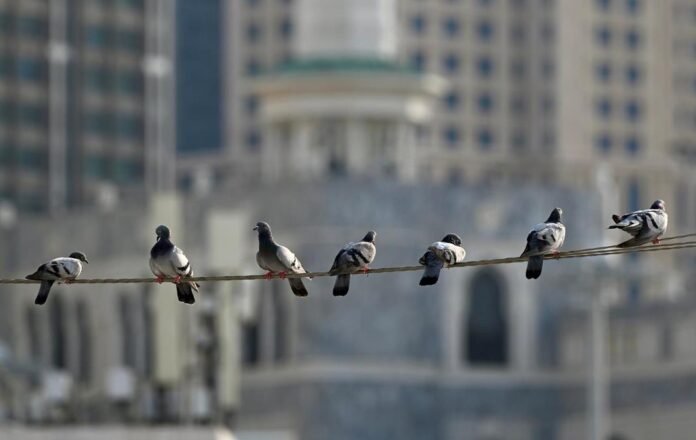
Makkah pigeons have remained part of the holy city’s landscape for centuries, connecting its historical heritage with everyday life. Their familiar presence around the Grand Mosque offers residents, pilgrims and visitors a distinctive reminder of Makkah’s traditions.
Locally, people call these birds Hamam Al-Hima, meaning Pigeons of the Sanctuary. Some also use the name Hamam Rabb Al-Bayt, referring to the Pigeons of the Lord of the House. Over generations, the birds have become associated with the city’s peaceful atmosphere and religious significance.
Their importance, however, extends beyond their presence in public spaces. Historical records describe how Makkah’s religious and cultural traditions recognized the protection of wildlife within the sanctuary. These accounts also document restrictions against hunting or disturbing animals inside its sacred boundaries.
Early historian Abu Al-Walid Al-Azraqi discussed these protections in his historical account, Akhbar Makkah. His work recorded religious and legal traditions concerning wildlife in the sacred precincts. Meanwhile, historian Muhammad Al-Fakihi documented poetry, literary references and customs connected with the pigeons.
Together, these historical accounts show how the birds became part of Makkah’s social identity. Their presence reflects a longstanding relationship between the city’s residents, religious traditions and natural surroundings.
Travelers from earlier centuries also described the pigeons as a familiar feature around the Grand Mosque. In his 1911 travel account, Al-Rihlah Al-Hijaziyyah, Egyptian historian Muhammad Al-Batnuni described large flocks gathering throughout the mosque’s courtyards and rooftops.
He also observed feeding and watering places that worshippers maintained for the birds. These details offer a glimpse into everyday practices that encouraged their continued presence. Furthermore, they show how caring for the pigeons became part of the city’s established customs.
Today, the birds continue to gather on rooftops, building ledges and open public spaces. Makkah’s urban environment provides shelter and feeding opportunities, allowing the flocks to remain visible throughout the city.
Their movements above central streets and open areas near the Grand Mosque have also become familiar sights for pilgrims. Many visitors photograph the birds as they circle above the surrounding architecture. Consequently, the pigeons have become part of the visual memories people take home from their journeys.
However, maintaining this longstanding coexistence requires careful attention to public cleanliness. Large numbers of birds gather in busy areas, particularly around plazas and pedestrian walkways. Therefore, local authorities must balance the birds’ presence with the comfort of worshippers and visitors.
The Holy Makkah Municipality carries out regular cleaning and sanitation operations in areas where pigeons gather. Municipal teams wash public spaces, remove leftover food and maintain cleanliness across frequently visited locations. These measures help protect environmental standards while supporting the city’s daily activities.
Makkah pigeons therefore represent more than a familiar feature of the city’s streets and rooftops. Their story connects historical records, religious traditions and the experiences of generations of visitors. From early travel accounts to modern pilgrimage photographs, the birds continue to reflect Makkah’s enduring cultural heritage.
Their continued presence offers a visible link between the holy city’s past and present. As Makkah welcomes pilgrims and visitors from around the world, these familiar flocks remain part of its distinctive atmosphere.
