
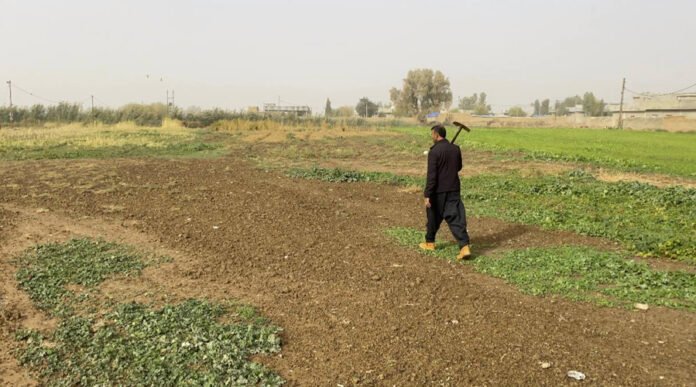
Kurdish farmers in Kirkuk face growing challenges as the land restitution law remains unimplemented. The ongoing disputes with Baath-era settlers threaten another grain-planting season. Farmers say immediate government action is crucial to protect their livelihoods.
In Laylan sub-district, Kurdish farmers report that Arab settlers are plowing lands owned by Kurdish families. “An Arab settler’s tractor is plowing my ancestors’ deeded land right in front of me,” said Mohammed Amin, a Tirkashkan village farmer. Local officials repeatedly warned settlers to stop encroaching, but they ignored the orders.
Iraq’s parliament passed a land restitution law in January to return properties confiscated from Kurds and Turkmen during the Baath regime. The law covers approximately 300,000 dunams, or 750 square kilometers, in Kirkuk and other disputed areas. However, authorities have not enforced it because the Council of State has yet to endorse it, and the Council of Ministers must still ratify it.
Abdullah Mirwais, head of Kirkuk Provincial Council’s agriculture committee, called for urgent coordination with Baghdad authorities. “The bill requires full cooperation with the federal government,” he said. He warned that further delays could harm Kurdish farmers’ crops and livelihoods.
Farmers also accuse the Kirkuk agriculture directorate of favoring settlers. “The directorate still renews contracts for Arab settlers,” said Sheikh Najat Talabani from Daquq district. He cautioned that this practice could trigger clashes. Similarly, Sami Ghafur from Topzawa village urged the Supreme Judicial Council to pause court cases against Kurdish farmers until official instructions for the land restitution law are released.
Land disputes in Kirkuk stem from Baath-era policies. In 1975, authorities declared several Kurdish villages prohibited oil zones and stripped residents of land rights. By 1977, the Supreme Revolutionary Court redistributed the lands to Arab settlers. Article 140 of Iraq’s constitution aimed to reverse these measures, but enforcement remains slow.
As the land restitution law stalls, Kurdish farmers lose one cultivation season after another. Swift enforcement of the land restitution law is essential to protect families, restore justice, and prevent further conflicts in Kirkuk.
