
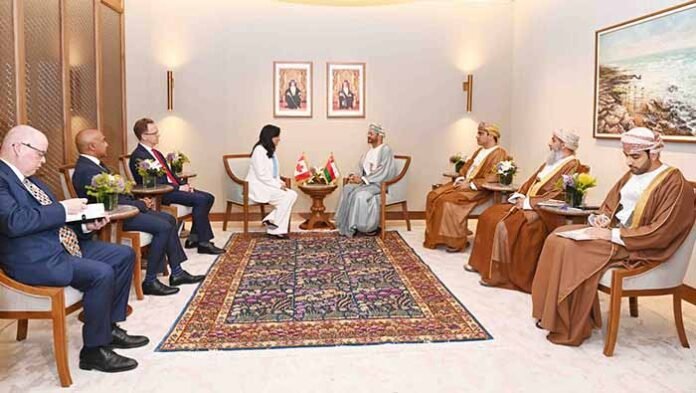
Oman and Canada are continuing to expand their diplomatic and economic relationship, building on ties that date back to 1974, according to official reports highlighting growing cooperation between the two countries.
Relations between Muscat and Ottawa have seen renewed momentum in recent years, with leadership-level communication and regular diplomatic exchanges reinforcing bilateral engagement. These interactions include phone calls between senior officials and ongoing consultations at international forums such as the United Nations General Assembly.
Diplomatic representation between the two sides also reflects this steady engagement, with both countries maintaining non-resident ambassadors and honorary consular arrangements to support coordination and dialogue.
Economic cooperation remains a central pillar of the relationship. A recent Canadian trade delegation visited Oman’s Ministry of Energy and Minerals to explore potential investment opportunities, particularly in mining and energy sectors. Officials on both sides have also held meetings with senior representatives of energy-related state institutions to discuss possible technical partnerships.
Canadian businesses maintain an established presence in Oman, with hundreds of companies operating in the local market across various sectors. Investment is estimated at tens of millions of Omani rials, reflecting steady commercial ties.
Education and training are also key components of cooperation. Oman continues to sponsor hundreds of students to study at Canadian universities, alongside sending medical professionals for advanced training. These initiatives are seen as part of long-term efforts to strengthen skills exchange and institutional development.
The broader context of the relationship also reflects Canada’s position as a diversified global economy with strong industries in energy, technology, manufacturing, and artificial intelligence. Meanwhile, Oman continues to pursue economic diversification under its long-term development strategies, including attracting foreign investment in non-oil sectors.
Against this backdrop, both countries are positioning their partnership as a model of steady but expanding cooperation, with energy transition, education, and investment expected to remain key areas of focus in the coming years.
