
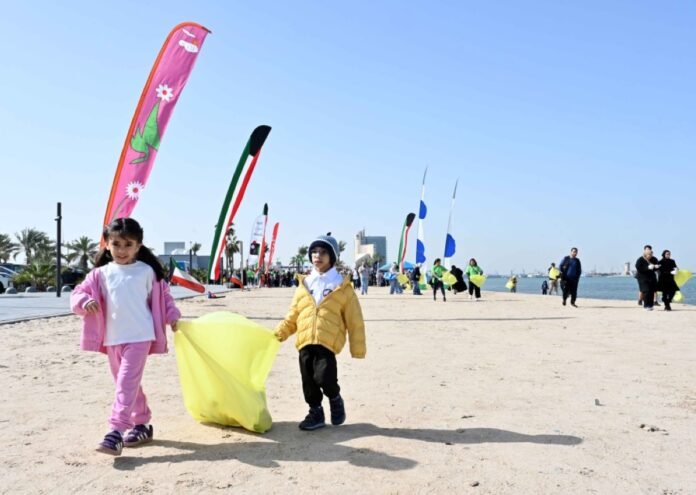
Protecting Kuwait’s beaches was the focus of a large cleanup event in Shuwaikh on Saturday. Around 500 people joined the campaign to highlight how litter affects both marine life and human health. Organizers emphasized that plastic pollution, sharp objects, and other hazards on beaches can reach humans through food, injuries, and medical risks.
The event was led by the Kuwait Institute for Scientific Research (KISR) with support from the Kuwaiti Diving Team and Kuwait Municipality. Experts explained that even a single plastic bottle can take up to 200 years to decompose. Microplastics then enter the food chain, affecting fish and eventually humans.
Metal-detecting volunteers also played a role. They recovered items buried under the sand, ranging from hazardous metals to valuable lost objects such as watches, phones, and jewelry. These items were returned to their owners, adding a community service dimension to the cleanup.
Marine scientists highlighted that protecting Kuwait’s beaches supports medical research. Many marine organisms in local waters have potential for pharmaceutical use. Algae, sea cucumbers, and sea urchins contain compounds with anti-cancer and anti-hypertensive properties. Researchers study DNA from these organisms to explore new medical treatments.
Students also joined the effort with creative projects. One marine science student developed non-toxic crayons using pigments extracted from local algae. These pigments are safe if accidentally ingested and have also been tested for makeup, including lipsticks and blushes. Using algae this way prevents it from harming marine life while creating valuable educational tools.
The campaign featured interactive activities such as scientific experiments, marine life learning, treasure hunts, and art projects. Artist Sahar Saan transformed discarded plastic bottle caps into a wave-shaped art installation. She explained that turning trash into art changes how people view waste, encouraging environmentally responsible behavior.
Experts noted that high human activity makes beaches vulnerable to pollution. Beach cleanups like this reduce environmental risks, protect marine biodiversity, and remind the public about the importance of protecting Kuwait’s beaches.
Overall, the event combined education, science, and creativity. By turning waste into art, participants learned how daily actions directly impact the environment. Protecting Kuwait’s beaches remains critical for both nature and human health.
