
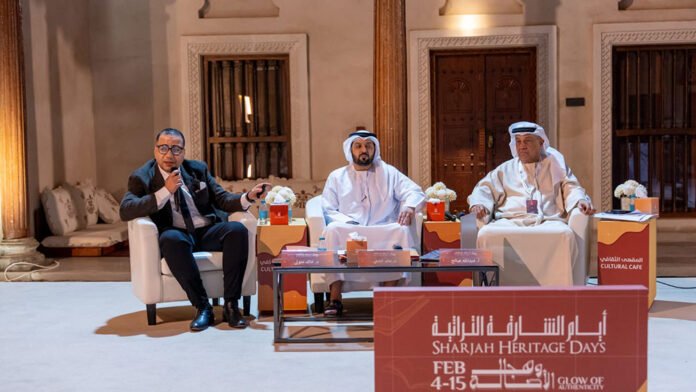
The Sharjah Heritage Days symposium continued its cultural and intellectual activities with strong public engagement. The event focused on identity and its expression in everyday life. Moreover, it explored how heritage shapes community awareness. The program created space for thoughtful dialogue on intangible cultural heritage.
As part of the event, Bait Al Naboodah hosted an intellectual session on traditional crafts. The session highlighted crafts as living expressions of memory and identity. Furthermore, speakers described crafts as bridges between past and present. They emphasized cultural continuity within modern society.
In the first session, artist Abdullah Saleh discussed memory through traditional crafts. He explained how crafts preserve the stories of places and people. Additionally, he shared personal experiences rooted in the Emirati environment. His presentation showed how people used local resources creatively.
Through examples, he demonstrated strong connections between craft and environment. He also highlighted how daily needs shaped professional traditions. Consequently, crafts reflected identity, survival, and creativity. His discussion reinforced the emotional value of handmade practices.
Meanwhile, the second session addressed continuity and renewal in traditional crafts. Dr. Khaled Metwally examined how modernization can support sustainability. He stressed development without losing cultural essence. Therefore, innovation must respect historical identity.
He also emphasized supporting artisans through institutional programs. Moreover, he highlighted education as a key preservation tool. Training new generations ensures knowledge transfer. As a result, crafts can survive changing social patterns.
The sessions emphasized that crafts represent more than physical objects. Instead, they reflect community values and environmental relationships. They also embody human resilience across generations. Therefore, heritage becomes a living social force.
Speakers agreed that preserving crafts strengthens national identity. In addition, they argued that heritage awareness builds cultural confidence. This understanding encourages community participation. Consequently, heritage remains relevant today.
The Sharjah Heritage Days symposium also focused on future cultural impact. Discussions highlighted investment in crafts through education and cultural initiatives. Participants exchanged ideas on modern presentation methods. These efforts aim to expand public appreciation.
The session moderation added academic depth to the dialogue. Dr. Khalid Al Shehhi guided discussions with balanced insight. He connected academic research with community practice. This approach enhanced intellectual exchange.
Toward the conclusion, attendees emphasized collective responsibility. Institutions and communities must support artisans continuously. Moreover, cooperation ensures heritage transmission to future generations. This process strengthens cultural sustainability.
Participants also stressed integrating crafts into contemporary cultural spaces. They supported cultural and educational investment strategies. These strategies preserve memory while encouraging innovation. Thus, heritage remains active and meaningful.
The Sharjah Heritage Days symposium reaffirmed crafts as living heritage. It highlighted their influence on present cultural identity. Ultimately, the event reinforced heritage as a shared responsibility. Cultural memory continues through practice, education, and community engagement.
