
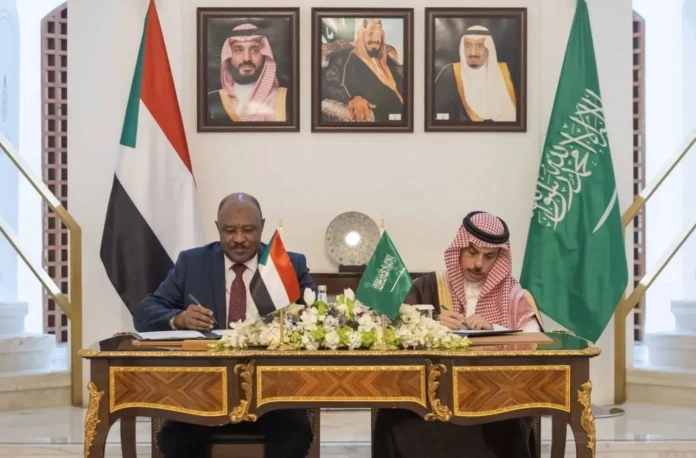
Saudi-Sudanese Council was established in Riyadh to strengthen coordination and expand cooperation between Saudi Arabia and Sudan.
Saudi Foreign Minister Prince Faisal bin Farhan and Sudanese Foreign Minister Mohieldin Salem Ahmed Ibrahim signed the agreement on Monday. The agreement creates a formal framework for both governments to coordinate bilateral priorities.
The signing took place in Riyadh during a meeting between the two foreign ministers. Officials said the new council reflects both countries’ interest in expanding cooperation.
The council will provide a platform for government entities from Saudi Arabia and Sudan. It will bring relevant institutions together around specific initiatives, projects and shared objectives.
Officials expect the new framework to support practical outcomes from bilateral cooperation. It will also provide a mechanism for both sides to coordinate work across different sectors.
Saudi Arabia and Sudan already maintain diplomatic and political relations. However, officials said the new structure can provide greater organisation for future cooperation.
The agreement focuses on strengthening coordination between institutions from both countries. It also aims to support cooperation and integration while addressing shared priorities.
The council will work toward initiatives designed to produce tangible results. Both sides will establish objectives that can guide cooperation between relevant government entities.
Saudi-Sudanese Council discussions are expected to cover areas connected with bilateral relations. The agreement itself does not specify individual projects or sectors for implementation.
Earlier on Monday, Prince Faisal and Ibrahim also co-chaired a meeting of the political consultation and follow-up committee. That meeting reviewed developments in relations between Saudi Arabia and Sudan.
The ministers discussed ways to strengthen bilateral ties across various sectors. They also exchanged views on recent regional developments during their discussions.
The political consultation committee provides another channel for officials to discuss relations. The new council adds a broader coordination structure involving relevant entities from both countries.
Saudi officials said the council reflects the aspirations of both nations’ leaderships and populations. The framework aims to turn bilateral cooperation into clearly defined initiatives and projects.
For Saudi Arabia, closer coordination with Sudan adds another institutional channel for engagement. For Sudan, the council provides a structured mechanism for advancing cooperation with Riyadh.
The agreement also creates an opportunity for government bodies to coordinate more closely. Rather than relying only on individual meetings, officials can use the council as an ongoing framework.
Saudi-Sudanese Council cooperation will depend on future initiatives agreed by participating institutions. The framework provides the structure, while individual entities will develop projects and objectives.
The signing also comes as both ministers continue consultations on regional issues. Their discussions included developments affecting the wider region and bilateral relations.
Neither side announced specific financial commitments or new commercial agreements during the signing. Officials instead focused on establishing a framework for future coordination.
The council could eventually support cooperation across several areas. However, further details will depend on future meetings and decisions by participating government bodies.
Saudi Arabia and Sudan will therefore have a formal platform for advancing bilateral priorities. The arrangement can also help both governments maintain regular institutional communication.
Saudi-Sudanese Council represents a new step in organising relations between Riyadh and Khartoum. Its effectiveness will depend on how quickly both sides translate its framework into practical initiatives.
The latest agreement demonstrates continued diplomatic engagement between Saudi Arabia and Sudan. It also provides a foundation for further consultations, cooperation and coordination between the two governments.
