
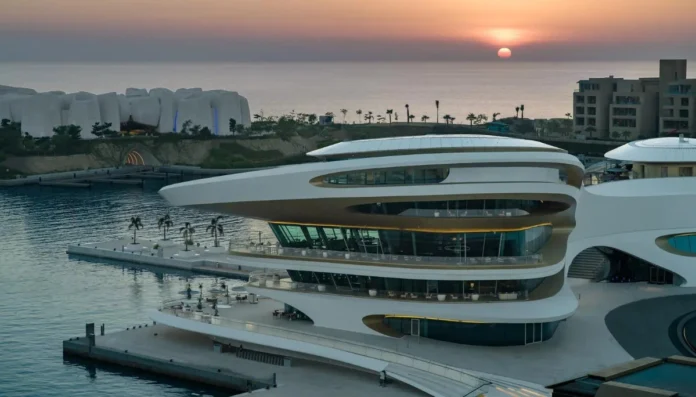
Saudi Arabia is expanding Red Sea Conservation efforts through scientific research, marine surveys and stronger environmental protection. Recent studies have mapped extensive seabed areas and identified previously undocumented marine species. These findings provide valuable information for protecting habitats and guiding sustainable development along the Kingdom’s coastline.
The Red Sea covers approximately 186,000 square kilometers and contains thousands of islands. It also supports one of the world’s largest coral reef systems. Recent investments have therefore expanded marine research beyond basic observation toward ecosystem management and long-term conservation.
A major seabed mapping project brought together the National Center for Wildlife, King Abdullah University of Science and Technology, and OceanX. Researchers published high-resolution seabed measurements using information collected during the 2022 Decade Expedition.
The study examined 860 kilometers of Saudi coastline, covering depths from two meters to more than 2,460 meters. Consequently, the findings help address gaps in seabed information and support better management of marine resources.
The National Center for Wildlife has also monitored biodiversity across 64 coastal locations. Additionally, researchers installed advanced sensors at 37 sites to measure sea surface temperatures. These observations provide baseline information that can guide national environmental policies.
The Decade Expedition delivered further scientific findings through extensive fieldwork and data collection. During 19 weeks, teams mapped 62,758 square kilometers of seabed and gathered over 2,800 biological and genetic samples. They also completed 44 crewed deep-sea dives and 133 missions using autonomous underwater vehicles.
Researchers identified four previously unknown coral species during the expedition. Other studies led by KAUST scientist Michael Berumen also highlighted previously undescribed marine species. Such discoveries strengthen scientific understanding of the region’s biodiversity and support future protected-area planning.
The Red Sea contains the world’s fourth-largest coral reef system. It represents approximately 6.2 percent of global coral reefs and hosts more than 310 coral varieties. These include around 270 hard coral species, making the region important for marine biodiversity research.
Another significant discovery involved more than 20 blue holes along the southern Red Sea coast. These geological formations provide habitats for corals, sponges, turtles and various fish species. Following surveys that recorded depths between 47 and 51.5 meters, authorities designated the Blue Holes a national marine reserve in 2025.
Meanwhile, the General Organization for Conservation of Coral Reefs and Turtles in the Red Sea, known as SHAMS, continues its monitoring programme. The five-year initiative covers 1,000 coastal locations, with 344 sites surveyed by late October 2026.
SHAMS has recorded 251 coral species, including 25 found nowhere else and 54 considered threatened. Its research has also identified 358 reef fish species across monitored locations. Furthermore, the organization completed 321 coral bleaching surveys and assessed environmental capacity at 72 sites.
Researchers also documented 46 giant coral colonies measuring more than five meters across. SHAMS maintains a coral nursery containing 380 colonies from 13 genera. Of those, 192 colonies are ready for future reef restoration projects.
Sea turtle protection represents another important part of the programme. In 2025, SHAMS confirmed 638 nesting sites across 23 ecological areas. These locations account for approximately 70 percent of sea turtle nesting activity in Saudi waters. The organization also established the Middle East’s first specialized sea turtle rehabilitation facility in 2024.
Technology is increasingly supporting these conservation and research activities. For example, ReefNetAI uses artificial intelligence to analyze coral images and identify species automatically. Researchers are also deploying marine robotics, remote sensing systems and autonomous underwater vehicles.
Additionally, environmental DNA techniques help scientists monitor species distribution while minimizing disturbance to marine habitats. KAUST researchers demonstrated the method’s effectiveness in the northern Red Sea during 2026. These tools can improve biodiversity monitoring and help researchers track changes over time.
The research also supports Saudi Arabia’s economic diversification plans under Vision 2030. Marine information can guide sustainable fisheries, aquaculture, coastal development and pharmaceutical research. Furthermore, detailed habitat mapping helps planners identify sensitive ecosystems and suitable areas for tourism and commercial activities.
Scientists consider Red Sea Conservation particularly important because some local reefs tolerate elevated sea temperatures. Their resilience makes them valuable for international research into climate adaptation. Researchers have also recorded critically endangered species, including leatherback sea turtles, inside the Blue Holes reserve.
The National Red Sea Sustainability Strategy sets an ambitious target for expanding marine protection. It aims to increase protected marine areas from three percent to 30 percent by 2030. Current priorities include completing coral assessments, monitoring ecosystems and identifying suitable reef restoration locations.
Authorities are also working with international organizations and research institutions on conservation initiatives. These partnerships include the International Union for Conservation of Nature, NEOM, King Abdulaziz University and KAUST. Together, their work aims to strengthen scientific knowledge and protect sensitive marine habitats.
Officials say these programmes will help position the Red Sea as a center for marine research and innovation. They also expect improved environmental data to support responsible development of the Kingdom’s blue economy.
