
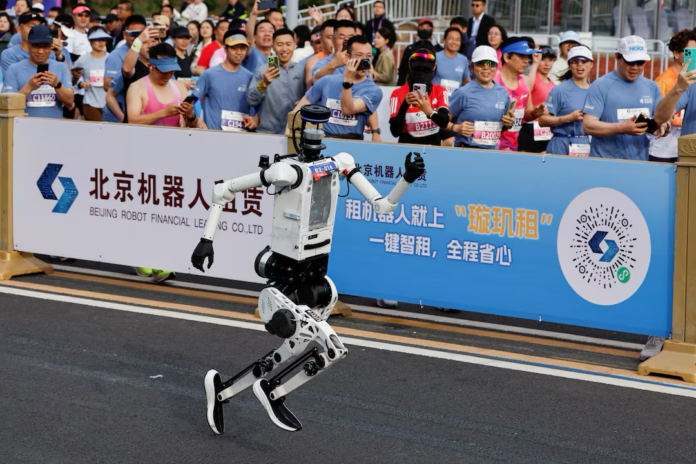
In a stunning robot race breakthrough, a humanoid machine outpaced elite human runners during a half-marathon in Beijing on Sunday. The event marked a major leap in robotics performance. Moreover, it signaled how quickly artificial intelligence and engineering continue to evolve.
The race took place in the Beijing Economic-Technological Development Area, also known as E-Town. Notably, organizers held the robot competition alongside a traditional human race. As a result, spectators witnessed a direct comparison between human endurance and machine precision.
A humanoid robot developed by Honor secured first place among robotic competitors. It completed the 21-kilometer course in 50 minutes and 26 seconds. Consequently, the robot beat the human half-marathon world record time. For comparison, Jacob Kiplimo clocked about 57 minutes earlier this year in Lisbon.
This robot race breakthrough highlights rapid progress since last year’s debut event. Back then, the fastest robot needed more than two hours to finish. However, engineers dramatically improved speed, balance, and navigation within just one year.
Despite the success, the race did not run perfectly. For instance, one robot fell at the starting line. Meanwhile, another crashed into a barrier during the course. Even so, most machines continued without major issues, which impressed the crowd.
Spectators reacted with surprise and curiosity. Many noted the visible improvements compared to last year. In addition, families and tech enthusiasts gathered to observe the machines closely. Some even suggested that robots may soon compete regularly with humans in endurance sports.
Organizers reported that about 40 percent of the robots operated fully autonomously. Meanwhile, others relied on remote control systems. Interestingly, a separate remotely controlled robot completed the race even faster. However, judges awarded victory based on a scoring system that favored autonomy.
Furthermore, other top-performing robots also came from Honor. They finished shortly after the winner, confirming the company’s strong presence in the field. At the same time, a robotic traffic officer guided runners using voice commands and arm signals.
This robot race breakthrough also reflects a broader technological race. China continues to invest heavily in robotics and artificial intelligence. In fact, its latest development plan prioritizes advanced technologies and real-world applications.
Additionally, research firm Omdia ranked several Chinese robotics companies among global leaders. These include AGIBOT, Unitree Robotics, and UBTech Robotics. Each company shipped thousands of units last year, which shows growing demand worldwide.
The event demonstrated how quickly robotics continues to advance. As innovation accelerates, experts expect machines to play larger roles in daily life. Therefore, what seemed impossible before now feels increasingly within reach.
