
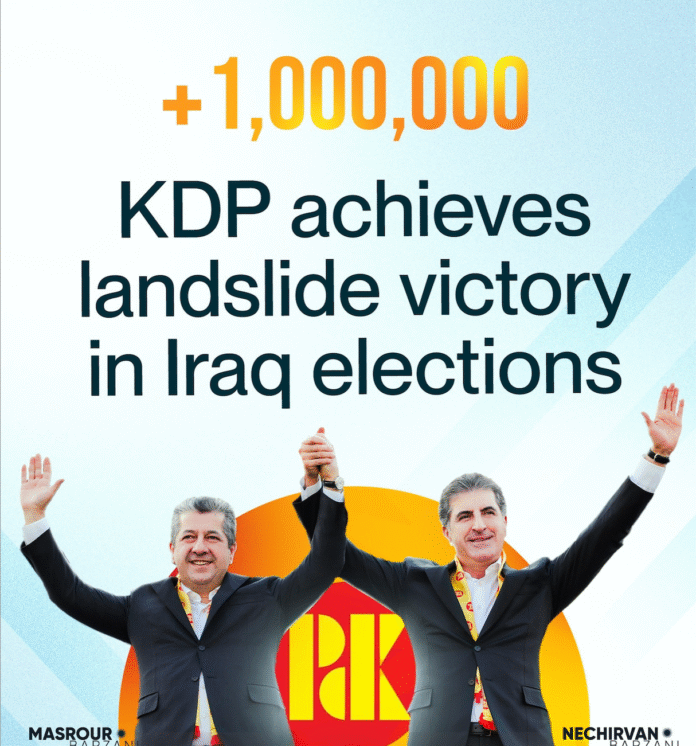
The Kurdistan Democratic Party (KDP) achieved a sweeping victory in Iraq’s legislative elections, capturing widespread support across the Kurdistan Region and disputed areas. The results positioned the KDP as the strongest Kurdish political force, securing over 9.4 percent of total votes nationwide.
The KDP’s victory reflects strong voter turnout and deep-rooted public trust in the party’s leadership. During Iraq’s legislative elections, the Independent High Electoral Commission reported about 10.9 million voters across the country. Among them, more than one million supported the KDP, a number celebrated by party leaders.
This strong showing followed the KDP’s “One Million Votes and More” campaign. The initiative, launched in early October, energized supporters and strengthened the party’s presence in every province. After the polls closed, the KDP leadership thanked voters for delivering historic support.
Meanwhile, the Patriotic Union of Kurdistan (PUK) trailed behind with roughly half the number of votes gained by the KDP. Projections suggest the PUK will hold about 18 of the 329 seats in Iraq’s parliament. Opposition parties, including Halwest, the Kurdistan Islamic Union (KIU), and the New Generation Movement (NGM), collectively gained 13 seats.
In Erbil, the KDP won 10 of the province’s 15 parliamentary seats, while the PUK and Halwest each secured two. In Sulaimani, results shifted sharply as the PUK dominated with eight seats. The newly formed Halwest movement earned three seats, marking a surprising rise.
Further north in Duhok, the KDP reaffirmed its dominance by capturing nine seats. In the disputed Kirkuk province, the PUK took six seats while the KDP claimed two. In Nineveh, the KDP gained five seats, reinforcing its strong presence across northern Iraq.
Throughout Iraq’s legislative elections, the Halwest movement emerged as a key winner among new parties. Its leader, Ali Hama Salih, successfully positioned the party as a growing alternative to older Kurdish factions.
In contrast, the NGM and Baray Gal suffered setbacks. Both parties faced leadership crises, with their founders currently imprisoned in Sulaimani. Their absence weakened voter engagement and reduced public confidence. Security tensions and property disputes further damaged their campaign efforts.
Nationwide voter turnout exceeded 55 percent, according to the Independent High Electoral Commission. Around 10.9 million Iraqis cast ballots, while more than 12 million participated in both early and general voting days. Officials said the outcome represented a step forward for Iraq’s democratic process.
Overall, the results of Iraq’s legislative elections highlight a major shift in Kurdish politics. The KDP’s dominant performance has reshaped the balance of power, signaling continued influence in both Erbil and Baghdad.
