
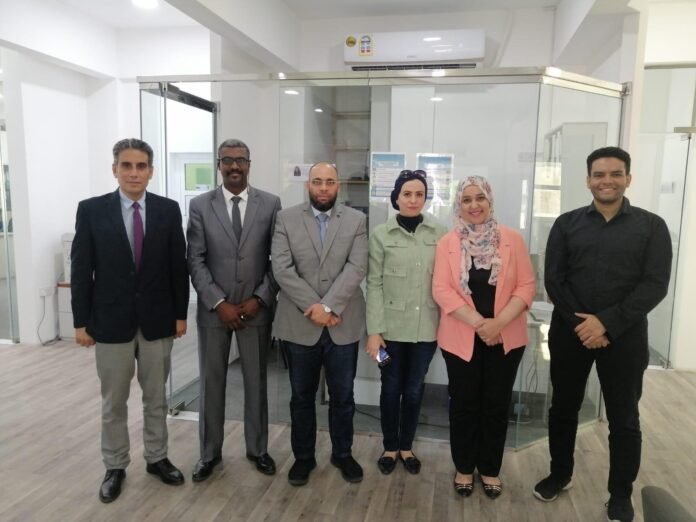
Gulf University continues to lead in media education. Recently, it participated in the First Joint International Conference of Media Colleges and Institutes in Cairo. The conference focused on “Media Education and Production in the Arab World in Light of Technological Development.” Professor Muhannad Al-Faraas, President of Gulf University, joined the first panel discussion, titled “Media Education and Training in the Age of Smart Technology: Preparing Media Professionals for a Digital Future.”
In his remarks, Al-Faraas emphasized the critical need to modernize media education curricula. As technology rapidly evolves, it is crucial for media education to keep pace. He further stressed the importance of preparing media professionals with the skills to adapt to innovations like artificial intelligence (AI) and big data. Therefore, he called for a rethinking of educational approaches to meet the demands of the digital era.
Al-Faraas pointed out that integrating AI tools into media education is essential. Media education institutions must reconsider their methods and embrace interactive, project-based learning. By adopting this approach, students will be better prepared to face future challenges in the media industry.
At Gulf University, the College of Communication and Media Technology leads this initiative. It is the first such college in Bahrain. The college boasts state-of-the-art facilities, including a television studio, a radio studio, a mobile studio, and a photography lab. As a result, these resources have made it easier for students to learn and use AI tools in content creation, reinforcing the university’s commitment to media education.
Moreover, field experience plays a key role in Gulf University’s media education approach. Al-Faraas explained that students must engage with real-world media production tools. This hands-on experience ensures they are job-ready upon graduation. Additionally, he noted that digital media is no longer optional. It has become the primary framework for shaping modern media messages.
Al-Faraas also highlighted the changing media consumption patterns. Today’s audience primarily uses digital platforms and social media. Therefore, Gulf University restructured its curriculum to address this shift. The program now includes digital content production, audience engagement strategies, and understanding distribution algorithms. Furthermore, students use AI-powered tools like Adobe FireFly, Canva AI, and FreePic to create written, audio, and visual content, further enhancing their media education.
In addition, Al-Faraas stressed the importance of continuous learning. Both students and faculty must stay updated on technological advances. Gulf University has developed a strategy to support ongoing training, ensuring that everyone remains at the forefront of media education. This forward-thinking approach guarantees the university remains competitive in the rapidly evolving media landscape.
Moreover, Gulf University’s College of Communication and Media Technology holds prestigious accreditation. It is a member of the Association of Colleges of Journalism and Mass Communication (ASJMC) and has international accreditation from the Royal Institute of Public Relations (CIPR). As a result, Gulf University’s media program is the second in the Middle East to achieve this distinction.
In conclusion, Al-Faraas called for greater collaboration between media education colleges, technology institutions, and the media production sector. Digital transformation in media education cannot happen in isolation. Consequently, cooperation is key to achieving a comprehensive vision for the future of media.
