
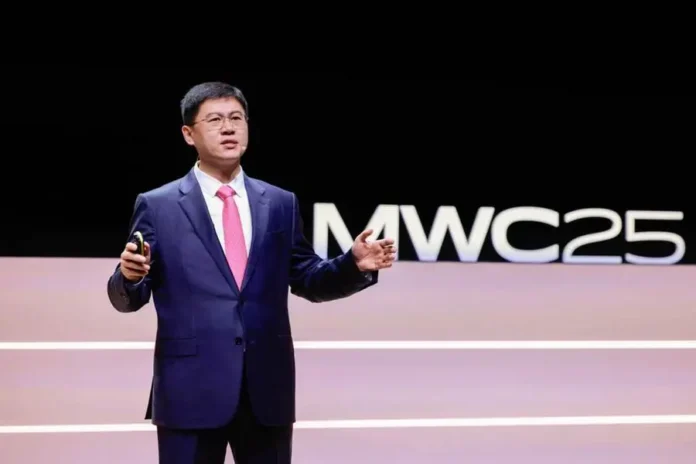
At MWC Barcelona 2025, Huawei showcased its vision for integrating artificial intelligence (AI) with 5G networks. They highlighted how carriers can maximize their potential. Li Peng, Huawei’s Corporate Senior Vice President and President of ICT Sales & Service, alongside Yang Chaobin, Director of the Board and CEO of the ICT Business Group, emphasized the transformative role of AI. AI is driving growth in data usage and revenue.
“We are stepping into an era of full intelligence. AI-driven applications are everywhere, demanding more from networks,” said Li Peng during his keynote. “By advancing 5G technology, we unlock the vast potential of mobile networks. Huawei is committed to collaborating with carriers and industry partners globally. We aim to enable digital transformation, strengthen network infrastructure, and embed AI into every aspect of connectivity.”
The rapid emergence of high-quality, cost-effective, and open-source AI models is fueling innovation across industries. From personalized consumer experiences to intelligent organizational collaboration, AI is reshaping how society interacts with technology. Additionally, human-machine interaction (HMI) is evolving from text-based communication to multi-modal formats. These incorporate voice, gestures, and real-time interactions. These advancements necessitate networks with guaranteed low latency. They are pushing the evolution from 5G NSA to 5G SA and eventually to 5G-A. To achieve this, carriers can implement technologies such as Control and User Plane Separation (CUPS). They can also use Guaranteed Bit Rate (GBR) to enhance network reliability for AI-driven applications.
Yang Chaobin introduced Huawei’s AI-Centric Network solution, aimed at helping carriers capitalize on AI opportunities. “This innovation transforms network capabilities, ensuring seamless connectivity across domains. It shifts network operations towards application-oriented management and redefines telecom business models to harness AI’s full potential,” he stated.
Carriers are also exploring new monetization strategies, moving beyond charging for data consumption to monetizing user experience. “Rather than just selling traffic, carriers can now generate revenue based on service quality, speed, and latency,” noted Li Peng. Many operators are already expanding into the B2B2C market by offering network capabilities through Open APIs.
Currently, 5G-A deployment is scaling up, with over 200 cities implementing the technology. Chinese carriers are collaborating with more than 100 industries to introduce AI-powered New Calling services via Open APIs. This significantly increases revenue from industry clients.
According to third-party projections, over one billion users will rely on cloud phones and cloud drives by 2030. They will require seamless access to cloud computing resources. Additionally, AI-powered in-vehicle applications will demand continuous connectivity across urban and rural regions. This ensures uninterrupted mobility experiences.
“The opportunities are massive, and the time to act is now,” concluded Li Peng. “Industry pioneers are already taking decisive steps to unlock new value.”
In 2025, commercial deployment of 5G-A will accelerate. AI will play a critical role in reshaping business models, infrastructure, and network operations. Huawei continues to work closely with carriers and global partners to drive the transition toward a more intelligent, AI-driven world.
MWC Barcelona 2025 runs from March 3 to March 6 in Barcelona, Spain.
