
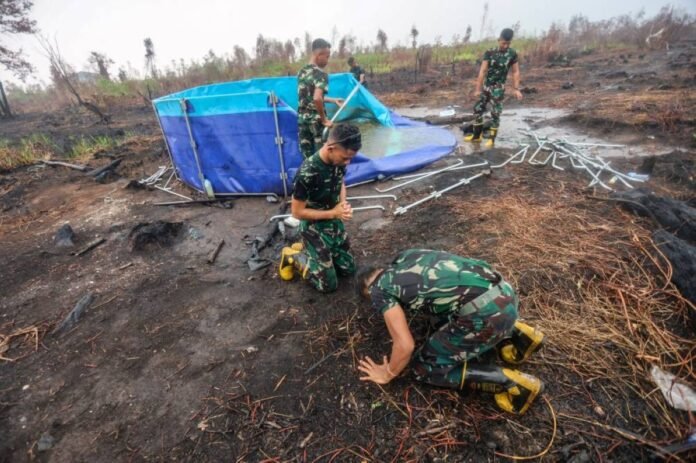
Indonesia wildfire haze brought months of dangerous air pollution to Palangkaraya, but recent rainfall has offered residents welcome relief. The city, located in Central Kalimantan on Indonesian Borneo, has endured widespread smoke since wildfires intensified in August. Consequently, residents and volunteer firefighters celebrated this week as showers temporarily improved conditions.
On Wednesday night, firefighters stepped into puddles and expressed gratitude as another downpour swept across the city. Exhausted volunteers welcomed the rain after spending weeks battling fires and dealing with persistent smoke. Firefighter Lukman El Hakim described the moment as deeply emotional, saying volunteers felt grateful to finally see rainfall.
The pollution has created serious health concerns throughout Palangkaraya during the prolonged fire emergency. More than 11,000 people have received treatment for respiratory infections, highlighting the impact of the hazardous conditions. Moreover, the city’s air quality index reportedly reached 4,000 this month, its highest recorded level and far above the hazardous threshold.
The recent showers also gave residents opportunities to resume outdoor activities after months of avoiding polluted air. Muhammad Jihan Alwi, a 23-year-old resident, returned to jogging and welcomed the improvement in conditions. However, the temporary relief does not mean the environmental crisis has ended.
Indonesia’s meteorology and climatology agency, BMKG, warned that dry weather could persist before the rainy season reaches its peak. Officials also cautioned that another dry spell could trigger fresh fires across affected areas. Although PM2.5 pollution levels have declined compared with the previous week, authorities still classify the air quality as unhealthy.
Meanwhile, Indonesia’s disaster management agency has deployed substantial resources to contain the fires and limit further damage. The agency reported operating 61 aircraft and helicopters across six provinces for cloud seeding and water bombing operations. Officials said cloud seeding helped encourage recent rainfall in Central Kalimantan, South Kalimantan and South Sumatra.
Nevertheless, the fires have taken a heavy toll on emergency personnel and communities. At least 11 people have died while fighting the blazes, including a 45-year-old forest ranger killed by a falling tree. The fatal incident occurred in North Toraja, South Sulawesi, on Wednesday.
Authorities have also pursued investigations into the causes of the widespread fires. National police official Asep Safrudin said investigators had named 245 individuals and 20 companies as suspects. Those facing allegations could receive prison sentences and substantial fines if courts establish their responsibility.
The fires burned more than 1.9 million hectares during the nine months ending in September, according to monitoring estimates. Smoke also travelled beyond Indonesia, reaching Malaysia, Singapore, the Philippines and Timor-Leste. Experts frequently link such fires to slash-and-burn land clearing associated with timber, palm oil and mining activities.
Although rainfall has reduced the immediate pressure on Palangkaraya, Indonesia wildfire haze remains a wider environmental and public health concern. Officials must continue monitoring air pollution, controlling active fires and preparing for possible renewed dry conditions. The coming weeks will help determine whether the rainfall signals lasting improvement or only a temporary pause.
