
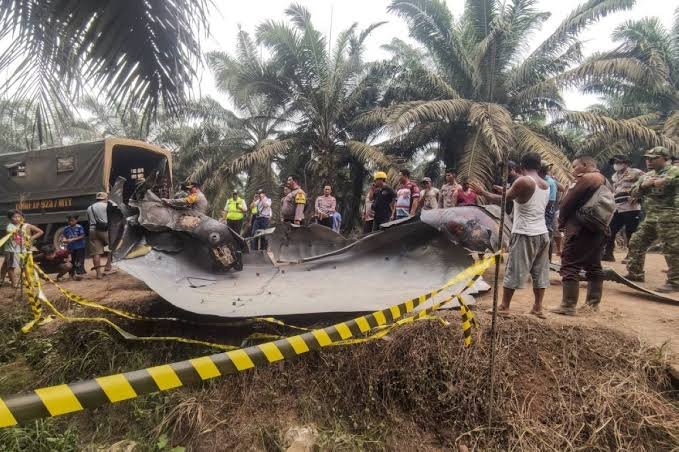
Indonesian authorities are investigating rocket debris believed to come from a Chinese launch. Fragments landed near homes and plantation work sites in Central Kalimantan, on Borneo island. Fortunately, officials reported no casualties or property damage.
A plantation worker discovered the first fragment on Monday morning near Sampit. Residents had reported hearing a loud bang the previous evening in the remote area. The discovery raised concerns because workers regularly operate near the impact site.
Wardi Tamroni, a 51-year-old plantation worker, initially mistook the object for aircraft debris. He found it about three kilometers from his employer PT Agro Bukit’s housing complex. Moreover, workers frequently carry out their daily activities near the location. Fortunately, everyone had left the plantation before the object landed.
Local police chief I Kadek Dwi Yoga Sidhimantra described the fragment as a large aluminium plate. He estimated that it measured up to nine meters long. The object also had an irregular shape and visible burn marks. These features prompted authorities to investigate its possible connection to a spacecraft re-entering Earth’s atmosphere.
Indonesia’s National Research and Innovation Agency, known as BRIN, identified a Chinese Zhuque-2E rocket as a possible source. China announced last week that a rocket of this type had launched ten satellites. The launch took place at a commercial facility in northwestern China. However, officials have not confirmed a direct connection between that mission and the Indonesian fragments.
BRIN researcher Thomas Djamaluddin explained that spacecraft components do not always burn up during atmospheric re-entry. In particular, heat-resistant materials can survive intense temperatures and reach the ground. Nevertheless, most falling debris lands in the oceans, which cover roughly 70 percent of Earth’s surface.
On Tuesday morning, authorities discovered a second suspected fragment about one kilometer from the first. Civil aviation spokesman Zachrudien said photographs showed a round object that appeared related to the earlier discovery. Investigators were examining both pieces at a nearby military airbase to determine their origins.
Meanwhile, aviation officials reported no identified radiation or toxicity risks from the recovered debris. They also confirmed that the incident caused no deaths or property damage. Even so, investigators are working to establish how the fragments reached an area near homes and workplaces.
The incident has renewed concerns about rocket debris as commercial space launches increase worldwide. The European Space Agency has warned that uncontrolled re-entry risks have grown alongside expanding space activity. Although individual risks remain relatively low, its Space Debris Office reported a considerable increase between 2019 and 2024.
For plantation workers, the discovery also raised questions about workplace safety. Tamroni acknowledged that employees could not easily predict or prevent such unusual incidents. Therefore, authorities must identify the fragments and determine whether additional debris could pose further risks.
The investigation continues as officials examine the recovered objects and assess the available evidence. Their findings could clarify whether the fragments came from the recently launched Chinese rocket. Until then, investigators consider the objects suspected space debris rather than confirmed components of that mission.
