
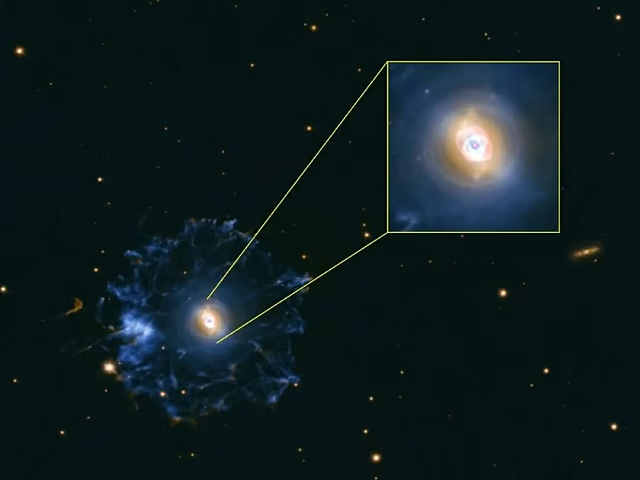
Astronomers at Al Khatim Astronomical Observatory successfully processed detailed deep-space exposures revealing the distant Cat’s Eye Nebula. Technical teams combined 724 individual raw exposures captured over nine consecutive days of intensive optical observations. Furthermore, imaging specialists utilized specialized narrow-band filters to highlight distinct chemical elements illuminating the expanding stellar structure. Consequently, astrophotography teams created an exceptionally sharp composite image displaying both inner shells and outer outer halos clearly.
The impressive astronomical project required over thirty-six total hours of accumulated camera sensor exposure time. Specialized equipment captured specific light emissions originating from hydrogen, oxygen, sulphur, and infrared spectrums continuously. Furthermore, technicians utilized a fourteen-inch reflecting telescope paired with a high-resolution monochrome camera throughout the observation campaign. Therefore, astronomical researchers mapped detailed structural features surrounding the dying central star across three thousand light-years distance.
Intricate gas structures within the glowing central core formed as a dying star shed outer atmospheric layers. Stellar winds colliding with previously ejected material sculpted intricate gas knots, high-speed jets, and shock wave concentric rings. Furthermore, space telescope observations suggest that binary star gravitational interactions shaped these complex non-spherical surrounding gas shells. Consequently, ongoing scientific analysis of NGC 6543 provides critical insight into evolutionary phases preceding white dwarf formation.
Capturing faint outer gas halos presents extreme technical difficulties due to immense brightness contrast variations. Specialized processing techniques brought out extremely dim gas filaments surrounding the luminous inner central core region. Furthermore, capturing these faint expanding shells allows astronomers to study older mass-loss events preceding final stellar collapse. Ultimately, successful imaging of the Cat’s Eye Nebula highlights advancing observational capabilities throughout the United Arab Emirates.
