
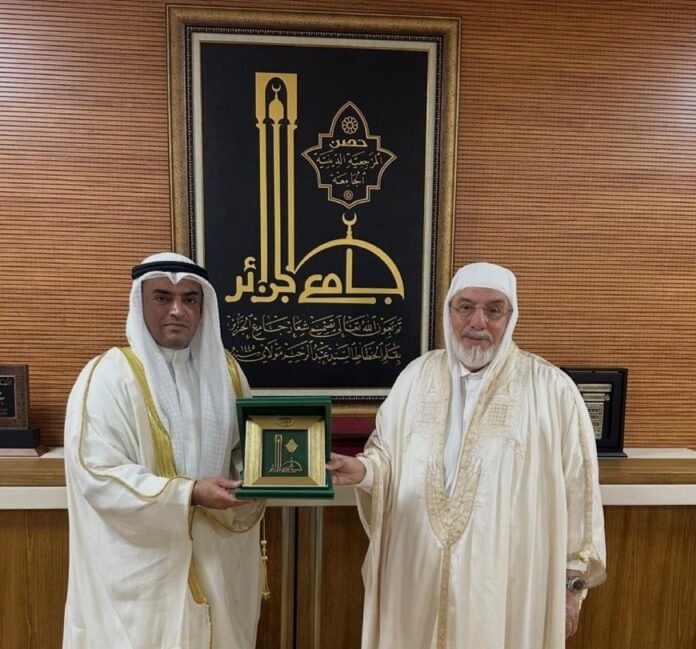
Religious Cooperation featured in talks between Kuwait’s ambassador to Algeria, Nawaf Boushaibah, and Sheikh Mohammed Al-Qasimi. Their meeting took place on Monday in Algiers and focused on expanding collaboration in religious affairs. Both officials discussed exchange visits, shared expertise, and stronger institutional connections between their countries.
Sheikh Mohammed Al-Qasimi serves as a minister of state and rector of the Great Mosque of Algiers. During the meeting, Boushaibah praised the mosque’s standing and its contributions to religious and cultural life. He also recognized its role in promoting Islamic values and encouraging constructive dialogue within society.
According to the Kuwaiti embassy, both sides explored practical ways to develop bilateral cooperation. They discussed building stronger links between Islamic institutions in Algeria and relevant organizations in Kuwait. Moreover, they considered opportunities to share professional experience and coordinate activities in areas of mutual interest.
The discussions included the Great Mosque of Algiers’ Center for Research in Religious Sciences and Dialogue of Civilizations. Participants also highlighted the National Higher School of Islamic Sciences, known as Dar Al-Quran. These institutions could provide channels for academic exchange, religious research, and dialogue between scholars and specialists.
Furthermore, the two sides expressed interest in organizing official visits to strengthen their institutional relationships. Such exchanges could allow representatives to learn about each country’s religious programs and areas of expertise. However, the meeting announcement did not specify dates, planned delegations, or particular initiatives arising from the discussions.
Religious Cooperation also formed part of a wider conversation about moderation, tolerance, and peaceful engagement. Both officials praised the Great Mosque of Algiers for promoting these values through its religious and cultural role. They also highlighted the importance of challenging extremism and hate speech through dialogue and education.
The participants commended the mosque’s leadership and staff for their work in preserving Islamic teachings. They emphasized the value of presenting Islam’s tolerant principles while encouraging understanding across different communities. In addition, their discussion underscored the role religious institutions can play in promoting respectful communication.
Kuwait and Algeria maintain diplomatic relations that provide a framework for exchanges across several fields. Cooperation involving religious institutions can complement those ties through professional contacts and shared cultural interests. Nevertheless, the reported meeting focused specifically on religious affairs rather than announcing broader political or economic agreements.
The talks also reflected an interest in connecting institutions rather than limiting engagement to government-level meetings. Research centers, educational bodies, and Islamic organizations could help sustain contact between scholars and practitioners. Through future exchanges, participating institutions may identify common priorities and opportunities for collaboration.
Religious Cooperation remains the central theme of the meeting, with both sides expressing support for continued engagement. Their discussions emphasized institutional links, official visits, expertise sharing, and the promotion of moderation. Neither side announced a formal agreement or a detailed timetable for future activities.
