
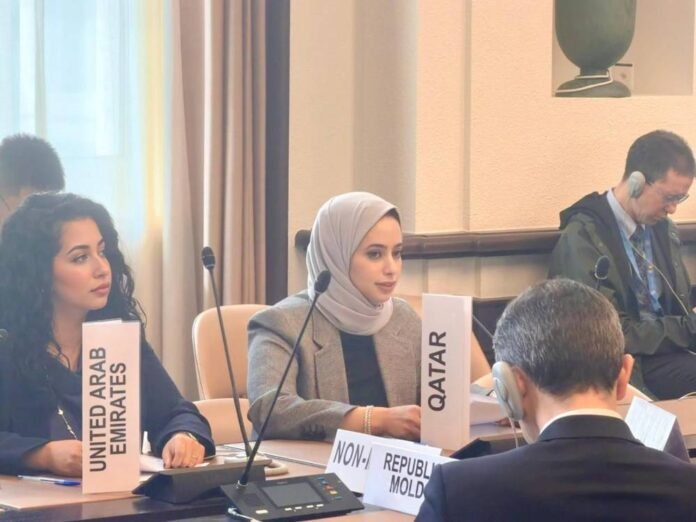
Qatar strongly condemned the recent attacks on Qatari territory, calling them a serious violation of sovereignty and international law. Officials warned that the escalation threatens regional stability and could widen tensions across the Middle East.
During a meeting of the Conference on Disarmament at the United Nations office in Geneva, Qatar’s representative delivered a clear message. The diplomat stated that attacks on Qatari territory cannot be justified under any circumstances. She also stressed that such actions violate the principles of good neighborly relations.
Furthermore, she explained that the missile strikes carried out by Iran represent a direct breach of the United Nations Charter. According to her remarks, the strikes also challenge established international legal norms. As a result, the incident raised serious concerns about stability across the Gulf region.
In addition, the representative emphasized that Qatar consistently avoids involvement in regional conflicts. Instead, the country often promotes dialogue between rival parties. For example, Qatar has supported communication channels between Iran and the wider international community.
However, the recent escalation has increased tensions across the region. The diplomat warned that continued confrontation could deepen instability and harm regional security. Therefore, she urged all sides to rely on diplomacy and peaceful dialogue.
Moreover, she pointed out that the strikes targeted civilian facilities and interests. Because of this, residents and citizens faced direct safety risks. She argued that these actions violate international humanitarian principles and threaten public security.
At the same time, Qatar reaffirmed its right to defend its sovereignty. Officials referenced Article 51 of the United Nations Charter. According to that principle, countries may respond to aggression when they face direct threats. Therefore, Qatar stated that it may take proportionate action to protect national security.
Meanwhile, regional developments have added further pressure. Airstrikes by the United States and Israel against Iran have intensified the situation. Consequently, Iran launched attacks targeting several Gulf states and other countries.
Because of these developments, Qatar urged all parties to prevent further escalation. Leaders warned that broader conflict could damage economic stability and humanitarian conditions across the region.
Finally, Qatar expressed solidarity with neighboring countries affected by the crisis. Officials condemned violations of sovereignty involving Saudi Arabia, Kuwait, United Arab Emirates, Bahrain, Oman, Jordan, and Iraq.
Officials stressed that diplomacy remains the only path to long-term stability. They warned that continued attacks on Qatari territory or other regional targets could trigger broader consequences for the entire Middle East.
