
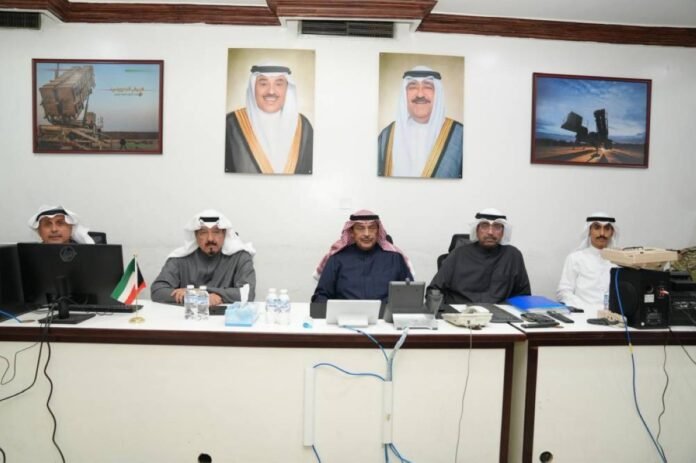
Military response to Iranian threats took center stage in Kuwait on Saturday. Military response to Iranian threats shaped high-level security discussions at key defense facilities. Senior leaders reviewed operational plans and assessed readiness levels across the armed forces.
According to official information, the Crown Prince Sabah Khaled Al-Hamad Al-Sabah and Prime Minister Ahmad Abdullah Al-Ahmad Al-Sabah visited the Joint Operations Center and the Air Force Operations Center at the Ministry of Defense. During the visit, they met senior military officials and command staff.
Defense Minister Abdullah Ali Abdullah Al-Salem Al-Sabah received the delegation upon arrival. Kuwait Army Chief of Staff Khaled Daraj Al-Shuraian also attended the meeting. In addition, Deputy Chief of Staff Sabah Jaber Al-Ahmad Al-Sabah joined the briefing session.
First, commanders outlined operational strategies designed to counter emerging risks. They explained how defense units responded to recent developments linked to Iran. Furthermore, they detailed surveillance measures and coordination efforts among military branches. Officials highlighted rapid response mechanisms and air defense readiness.
Moreover, military leaders presented updates on troop deployment and equipment positioning. They described how forces strengthened defensive lines. They also emphasized coordination between ground forces and air units. As a result, the leadership gained a comprehensive overview of national defense capabilities.
During the session, the Crown Prince and Prime Minister asked direct questions about contingency planning. They requested clarification on preparedness levels. They also stressed the importance of maintaining high alert status. Consequently, commanders reaffirmed their commitment to protecting national security.
Meanwhile, additional senior officials accompanied the visit. Among them were Minister of Amiri Diwan Hamad Jaber Al-Ali Al-Sabah and the head of the Crown Prince’s Diwan Thamer Jaber Al-Ahmad Al-Sabah. Their presence reflected broad governmental coordination on security matters.
Importantly, military response to Iranian threats remains a central priority for Kuwait’s defense establishment. Leaders continue to evaluate risks in light of regional tensions. At the same time, defense institutions aim to ensure operational efficiency and rapid mobilization capacity.
In conclusion, Saturday’s visit underscored unified leadership during heightened regional uncertainty. Kuwait’s senior officials reviewed defense strategies carefully. They reinforced the armed forces’ readiness to address evolving challenges and safeguard national stability.
