
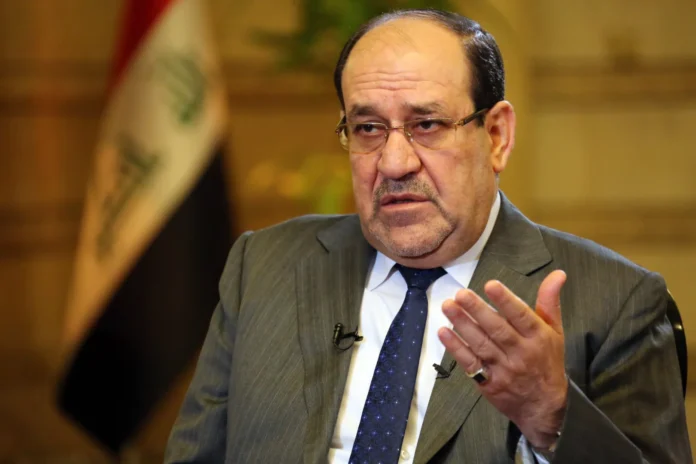
Iraq’s political scene shifted again on Saturday as Nouri al-Maliki arrived in Erbil for high-level talks that could shape Iraq’s national direction. His party, the Islamic Dawa Party, quickly moved to nominate him for prime minister, marking a bold step during intense government-formation negotiations.
Maliki reached Erbil soon after final election results created fresh uncertainty in Baghdad. He leads the State of Law Coalition, which secured 29 seats out of 329 seats after the November 11 vote. Party officials said he holds the experience to guide Iraq through this sensitive stage, and that experience continues to influence the wider national direction.
Soon after his arrival, Maliki met Fuad Hussein, a senior figure in the Kurdistan Democratic Party (KDP). They discussed the post-election phase and stressed the need to keep the results focused on citizens’ needs. Maliki then held a longer meeting with KDP leader Masoud Barzani. Both sides agreed to continue talks with other political forces, and they also highlighted the importance of balanced negotiations during this complex period.
Tensions between Maliki and Erbil remain part of the political memory. Maliki cut the Kurdistan Region’s federal budget share in 2014 after disputes over independent oil exports. He also sent federal forces toward the region’s borders twice and threatened action during the 2017 independence referendum. Yet leaders in Erbil and Baghdad now show new willingness to coordinate, especially with the next government still unformed.
The KDP, which won 27 seats with more than one million votes, shares strong interest in resolving old disputes. Masrour Barzani, the Kurdistan Region’s prime minister and a KDP deputy leader, met Maliki as well. Both leaders stressed the need to settle Erbil-Baghdad issues through the constitution and existing agreements. They also agreed to support a stable national direction as political talks advance.
Meanwhile, the Shiite Coordination Framework, which includes Maliki, announced that it formed the largest parliamentary bloc. This step gives the bloc authority to nominate the next prime minister. However, discussions remain active because several leaders continue to review different candidates. The Coordination Framework recently created two committees: one to negotiate national entitlements and another to interview prime ministerial hopefuls.
Former prime minister Mustafa al-Kadhimi remains a nominee. Hikma Movement member Fahd al-Jubouri confirmed ongoing interviews for several names. Sudani, the current prime minister, still seeks a second term, yet shifts inside the Coordination Framework could affect his chances.
Under Iraq’s system, parliament must meet with a two-thirds quorum before electing a speaker. Lawmakers then choose a president, and the largest bloc nominates a prime minister-designate. Therefore, every meeting in Erbil carries weight, and every agreement shapes the next chapter.
Iraq now stands at another crossroads, and leaders across the country push for clarity. Although negotiations continue, all sides appear aware that citizens expect political stability, economic progress, and a clear path forward.
As talks deepen, Iraq’s leadership battles over influence and alliances, yet the broader goal stays the same: protect the country’s future and define its national direction.
