
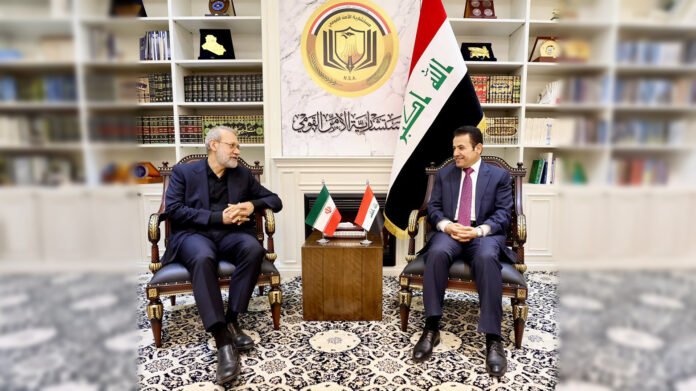
The Iraqi–Iranian Security MoU has reignited discussions in Baghdad about sovereignty, border control, and regional rivalries. Officials signed the agreement in the capital, aiming to expand previous security arrangements into a broader cooperation framework.
The deal upgrades a 2023 border security pact and focuses on several urgent issues. It strengthens border protection, targets armed opposition groups in the Kurdistan Region, and prevents the rise of militant models in frontier areas. It also sets up intelligence sharing, joint patrols, anti-drug operations, and monitoring of ISIS movements. The border between both countries stretches about 1,450 kilometers, with roughly 600 kilometers inside the Kurdistan Region.
National Security Advisor Qassem al-Araji said the March 2023 agreement served as the foundation for the new MoU. That earlier deal addressed cross-border attacks by dissident groups. Now, officials seek a more permanent structure for coordination.
However, the pact has stirred political criticism. Parliamentary Security as well as Defense Committee member Kareem Abu Souda objected to the lack of legislative review. Parliament is currently suspended, leaving no opportunity for formal approval. He insisted that any international deal must follow constitutional procedures.
In addition, security analyst Sarmad al-Bayati argued that the Iraqi–Iranian Security MoU benefits both sides. He linked it to the recent withdrawal of armed Iranian opposition factions from Iraq and stated there are no secret clauses.
Some lawmakers voiced strong support. MP Mukhtar al-Moussawi recalled Iran’s assistance during the 2014 ISIS crisis and described the agreement as proof that Iraq is not isolated.
Yet the United States criticized the deal. The State Department warned it could weaken Iraq’s defense institutions and increase dependence on Iran. Washington argued that the pact undermines independent military development.
Baghdad’s embassy in Washington rejected these claims, affirming Iraq’s independent decision-making. Officials stressed that Iraq maintains balanced ties with neighbors and the US.
Iran’s embassy in Baghdad also condemned Washington’s position. Tehran called it interference in relations between two sovereign states and accused the US of pursuing destabilizing regional policies.
The Iraqi–Iranian Security MoU has clearly become more than a border agreement. It is now a focal point in the ongoing struggle between regional cooperation and external influence.
