
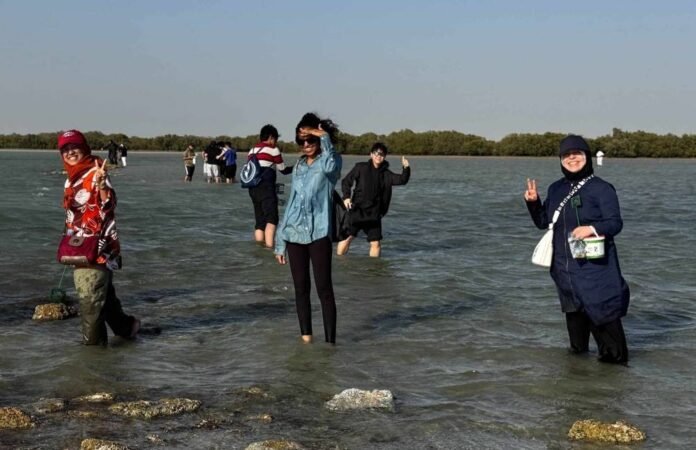
First-year pre-medical students at Weill Cornell Medicine-Qatar (WCM-Q) explored Qatar’s rich biodiversity during a February field trip to Jazirat Bin Ghannam, also called Purple Island. The excursion allowed students to observe local ecosystems and understand species adaptations.
The students visited the island in three groups on separate days. They identified and collected invertebrates and studied how plants and animals have adapted to the coastal environment.
Under the guidance of Dr. Kuei-Chiu Chen, a WCM-Q biology professor, students collected invertebrate specimens for laboratory analysis. At WCM-Q’s advanced lab, they processed tissue samples and extracted DNA sequences to identify species.
The students examined various marine invertebrates, including clams, crabs, snails, sponges, shrimp, sea stars, moss animals, and segmented worms. To protect the ecosystem, each student pair collected only one specimen.
In addition to marine life, students studied plant species such as gray mangrove (Avicennia marina). Zygophyllum qatarense, and glaucous glasswort (Arthrocaulon macrostachyum), which survive in salty coastal soils. They also learned about sea lavender (Limonium axillare), with its purple spring flowers, and the parasitic desert hyacinth (Cistanche phelypaea), which lacks chlorophyll.
The field trip was part of the first of three biology laboratory classes, where students applied DNA to identify species. Dr. Chen explained, “This trip gave students the chance to see species in their natural habitat and connect outdoor exploration with laboratory techniques.” He added that DNA barcoding helps students understand the diversity of life in a hands-on way.
Student Noof Al Malik said, “The Purple Island trip connected classroom theory to nature. It highlighted evolution, species interactions, and even Qatar’s history.” Minu Kim added, “Observing complex ecosystems firsthand made learning more engaging and meaningful than textbooks alone.”
While combining fieldwork with modern laboratory techniques, WCM-Q provided students with a unique opportunity to study Qatar’s rich biodiversity, fostering curiosity, critical thinking, and a deeper appreciation for the environment.
