
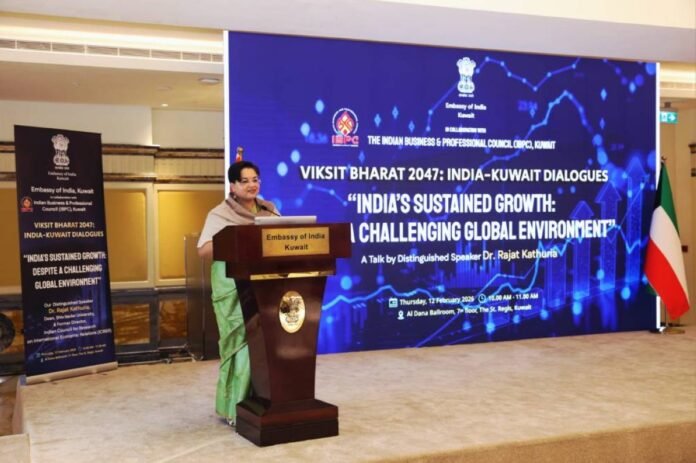
Viksit Bharat 2047 took center stage in Kuwait as the Indian Embassy launched its India-Kuwait Dialogues. The initiative aims to create a platform for dialogue, collaboration, and knowledge exchange between India and Kuwait. Through talks, discussions, and presentations, the program seeks to highlight India’s economic progress, innovation, and opportunities for bilateral partnerships. It also promotes connections across business, technology, arts, and cultural sectors.
The inaugural session was organized in collaboration with the Indian Business & Professional Council (IBPC). Renowned economist Dr Rajat Kathuria, Dean of Shiv Nadar University, delivered the keynote address. His talk focused on “India’s sustained growth: Despite a challenging global environment.” More than 100 participants attended, including economists, business leaders, investors, entrepreneurs, and media representatives.
The ambassador of India to Kuwait, Paramita Tripathi, opened the event by highlighting India’s strong economic trajectory. She noted India remains the world’s fastest-growing major economy and is projected to reach a $5 trillion economy by 2030. She emphasized the synergy between Viksit Bharat 2047 and Kuwait’s Vision 2035. These synergies offer opportunities for co-investment, technology partnerships, and policy collaboration, setting benchmarks for South–South cooperation.
Dr Kathuria presented India’s economic indicators and growth strategies. He highlighted the Union Budget 2026, which reinforces fiscal prudence, structural reforms, and inclusive growth. He also explained how India’s strong consumer base and domestic demand stabilize the economy. The increase in infrastructure investment, including roads, railways, ports, airports, and metro systems, supports private-sector growth and foreign investment.
Following the keynote, a lively Q&A session explored global economic uncertainties, regulatory stability, and sector-specific opportunities. Participants discussed investment prospects in infrastructure, renewable energy, manufacturing, and digital innovation. They also addressed policies to enhance ease of doing business and investor confidence.
Kaizar Shakir, Chairman of IBPC Kuwait, noted that India’s reform-focused budget aligns closely with Kuwait’s Vision 2035. He emphasized that collaboration in economic and technological sectors can unlock new opportunities and strengthen bilateral partnerships.
The Viksit Bharat 2047 initiative reflects the Indian Embassy’s commitment to fostering meaningful engagement and dialogue between India and Kuwait. By promoting economic, technological, and cultural exchanges, it aims to build sustainable, long-term collaboration. This platform encourages investors, policymakers, and innovators to explore new avenues of growth while supporting shared goals for the future.
