
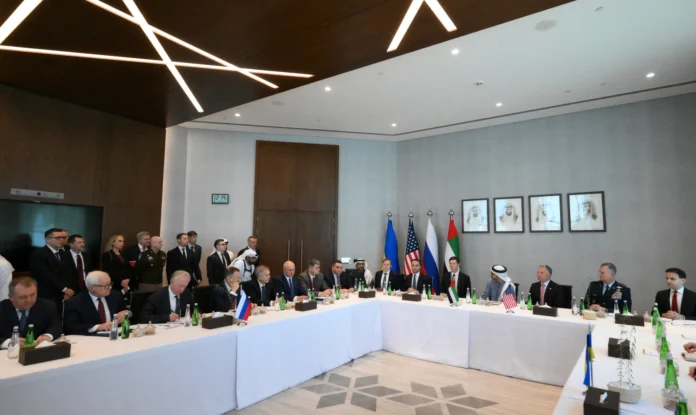
US-mediated Abu Dhabi Talks between Russia and Ukraine began on Tuesday, November 10, bringing the opposing sides together. The discussions mark their first trilateral meeting in more than nine months, with American representatives leading negotiations.
The meeting brings together delegations from Moscow and Kyiv, alongside US envoys Jared Kushner and Steve Witkoff. A photograph released by Russian state media showed representatives seated opposite each other, with American officials at the table’s head.
European countries also sent representatives to the UAE capital, reflecting concerns about the negotiations’ possible consequences. Their involvement follows comments from US President Donald Trump about a potential agreement involving European security.
Trump has repeatedly called for an end to the conflict since returning to office. However, previous diplomatic efforts failed to produce significant progress, while the US-Israeli war against Iran disrupted negotiations.
European governments and Ukraine worry Washington could pressure Kyiv into accepting terms that undermine its interests. These concerns have intensified following Trump’s apparent shift towards Moscow during recent discussions.
Russia launched its full-scale invasion in February 2022, triggering a devastating conflict with enormous human consequences. The fighting has killed hundreds of thousands, displaced millions, and continued for approximately 56 months.
Ahead of the meeting, Trump suggested Ukraine might eventually surrender territory as part of a settlement. He said the country could emerge with a different shape following negotiations.
Russian forces control substantial Ukrainian territory, although they have not captured the entire Donetsk region. Moscow continues demanding that Kyiv surrender the remaining areas it controls there.
Russia has threatened to continue its military campaign unless Ukraine accepts those territorial demands. However, Ukrainian officials have repeatedly rejected any withdrawal from the territory.
Meanwhile, Russian forces intensified attacks before negotiations began, including a deadly strike on a frontline village. Ukrainian authorities reported that 55 people died while queuing for humanitarian assistance.
President Volodymyr Zelensky described the increased attacks as an attempt to weaken Ukraine’s negotiating position. He argued that Moscow was applying military pressure while diplomatic discussions approached.
Russian President Vladimir Putin has repeatedly rejected broader ceasefire proposals and direct meetings with Zelensky. Consequently, expectations surrounding the latest Abu Dhabi Talks remain limited among Ukrainian officials.
A senior Ukrainian official in Kyiv said the government held no particular expectations. Nevertheless, Kyiv continues exploring possibilities for reducing violence through diplomatic engagement and local agreements.
European security concerns have also become central to the wider diplomatic discussions. Trump recently suggested a substantial agreement could involve Europe and reshape broader regional security arrangements.
His comments raised concerns that Washington and Moscow might negotiate European security matters without sufficient European involvement. German Foreign Minister Johann Wadephul rejected the idea of creating an entirely new European security structure.
He also urged Russia to abandon maximalist demands and warned against negotiations that produce little practical progress. Meanwhile, Zelensky invoked the phrase “Yalta 2.0” to describe fears of powerful countries dividing Europe.
The reference recalls the 1945 Yalta Conference, when Allied leaders discussed Europe’s postwar arrangements. Ukraine fears decisions about its future could emerge without adequate consideration of its sovereignty.
Ukraine’s chief negotiator, Rustem Umerov, said representatives from Britain, France, Germany and Italy would attend separate discussions. NATO and European Union officials would also meet with Ukrainian representatives in Abu Dhabi.
However, the Kremlin has insisted that the main negotiations remain trilateral. Moscow has also sought to limit Europe’s direct participation in discussions with Russia.
Ukrainian political expert Volodymyr Fesenko identified a recent Kherson ceasefire as a positive development. He suggested Kyiv could pursue similar local arrangements to reduce fighting.
The latest Abu Dhabi Talks therefore face significant obstacles, including territorial disputes and disagreements over European security. Still, the meeting creates another diplomatic opportunity amid continuing military operations and widespread uncertainty.
