
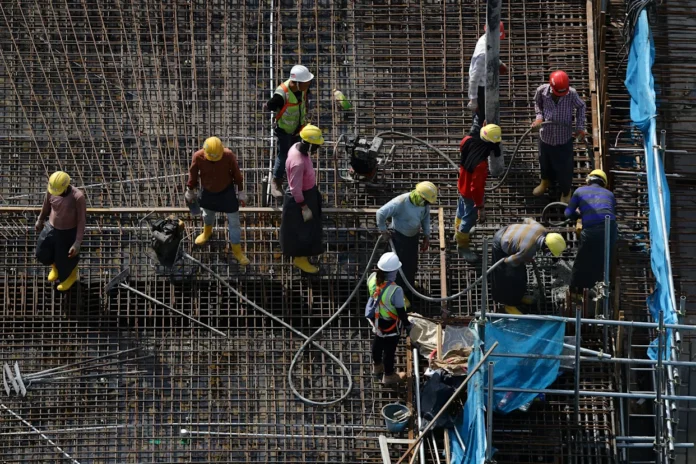
The UAE labour market growth continues to impress as new data from the Federal Competitiveness and Statistics Centre (FCSC) shows remarkable progress in 2024. The country’s labour force reached a record 9.4 million individuals, marking a strong rise from 2023. Alongside this growth, the unemployment rate dropped to 1.9%, one of the lowest in the world. These numbers highlight the UAE’s commitment to economic expansion and its position as a global leader in workforce competitiveness.
According to the FCSC, the economic participation rate among individuals aged 15 and above increased to 81.4%, compared to 78.5% in 2023. This rise demonstrates how national initiatives continue to create opportunities and boost employment across various sectors. The UAE labour market growth reflects an ongoing effort to provide a stable, diverse, and future-ready workforce.
The International Institute for Management Development (IMD) ranked the UAE first globally in the Labour Force Growth Index for 2025. It also placed the nation among the top five worldwide in several other indicators. These include second place in both Labor Force Percentage and Foreign Labor Force Percentage. Third in Availability of Skilled Labor, fourth in Labor Regulations, and fifth in Unit Labor Cost. Such rankings emphasize the country’s effective policies and its ability to attract skilled professionals from around the world.
Hanan Ahli, Director of the FCSC, said the results of the 2024 Labor Force Survey are not just statistics but proof of the UAE’s successful strategies. She noted that the nation continues to develop an ideal environment that supports sustainable growth and empowers both local and foreign workers.
The survey showed that 81% of the labour force is male, with 7.5 million men and 1.7 million women. The private sector leads the market, employing 85% of the total workforce, equivalent to 7.8 million people. The government, diplomatic missions, and non-profit organizations make up the rest.
Youth unemployment also saw a sharp decline, dropping from 16.7% in 2023 to 5.2% in 2024. This improvement reflects how the UAE’s economic and social policies are helping young people join the workforce.
Data revealed that 96% of all employed individuals are wage earners, while 3% are self-employed or employers. Most workers belong to the 30–39 age group, showing strong participation from prime working-age individuals.
The UAE labour market growth continues to set a global example. With strong leadership, inclusive policies, and a thriving private sector, the UAE is shaping one of the most competitive labour markets in the world.
