
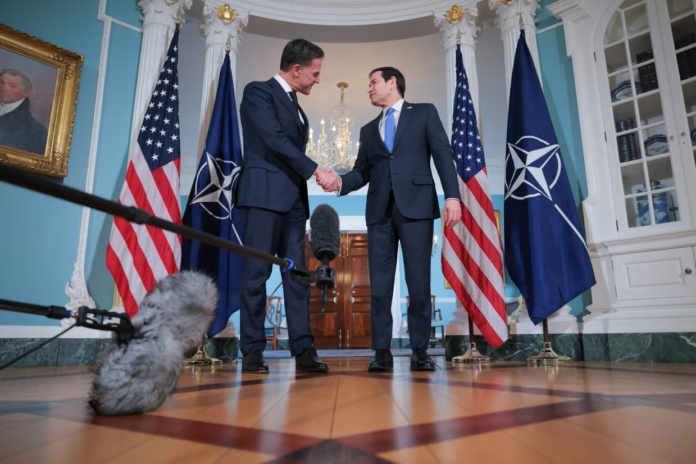
US President Donald Trump expressed frustration as NATO allies refused to join the US military campaign against Iran. The NATO allies’ stance disappointed Trump during a private meeting with Secretary General Mark Rutte in Washington.
Rutte described the exchange as “very frank, very open,” but did not confirm whether Trump raised the possibility of leaving the alliance. The meeting came less than a day after the US and Iran agreed to a two-week ceasefire, including reopening the Strait of Hormuz.
Trump warned Iran that failing to secure safe passage through the strait could result in “a whole civilization” being destroyed. However, he criticized NATO allies for ignoring US calls for military support. He described the alliance as a “paper tiger” in a public statement.
In a post on Truth Social, Trump wrote, “NATO WASN’T THERE WHEN WE NEEDED THEM, AND THEY WON’T BE THERE IF WE NEED THEM AGAIN. REMEMBER GREENLAND, THAT BIG, POORLY RUN, PIECE OF ICE!!!”. His frustration also stems from past disputes over Greenland and perceived lack of support from European partners.
White House Press Secretary Karoline Leavitt acknowledged that Trump discussed leaving NATO, though US law prevents a president from withdrawing without congressional approval. Rubio, now Secretary of State, had championed the law in 2023 while serving as a senator.
Senator Mitch McConnell urged Trump to support the alliance and focus on deterring adversaries. He emphasized NATO allies’ contributions in past conflicts, including Afghanistan and Iraq. The alliance relies on a mutual defense principle, activated only once in 2001.
Trump also criticized Spain and France for restricting US use of airspace and military facilities during the Iran war. He argued that protecting the Strait of Hormuz should be the responsibility of oil-dependent nations, not the US alone.
Mark Rutte met with Secretary of State Rubio earlier, discussing the Iran war, the Russia-Ukraine conflict, and enhancing NATO coordination. Meanwhile, British Prime Minister Keir Starmer is preparing to visit the Gulf to support the ceasefire and develop a post-conflict security plan for the strait.
As NATO allies remain hesitant, Trump’s discontent highlights growing tensions within the alliance over burden-sharing and military commitments. NATO allies now face pressure to respond to US demands while maintaining regional peace.
