
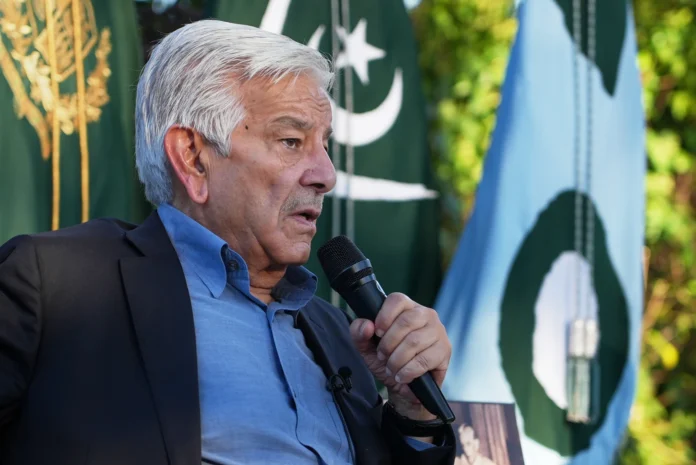
Saudi Defense Support has become a central issue after Pakistan’s defense minister said Islamabad would defend Saudi Arabia using available means. Defense Minister Khawaja Muhammad Asif made the statement Tuesday while speaking with reporters during a visit to Rome. However, he did not confirm whether Pakistani forces had already participated in airstrikes against Iranian operators in Yemen. Instead, he said Pakistan’s military capabilities would remain available to Saudi Arabia under the countries’ new defense arrangement.
Asif said Pakistan had committed itself to defending Saudi Arabia under the Makkah Joint Defense Agreement. He declined to provide specific details about possible Pakistani military involvement in current operations. Nevertheless, he described Pakistan’s commitment as clear and said available capabilities could support Saudi Arabia. His comments represent a stronger indication of Islamabad’s position amid escalating regional security tensions.
The defense minister also stopped short of confirming whether Saudi Arabia had formally requested Pakistani military assistance. Therefore, his remarks establish Pakistan’s stated commitment without confirming direct involvement in ongoing airstrikes. This distinction remains significant as officials continue developing the practical framework for the new trilateral defense agreement. The arrangement involves Pakistan, Saudi Arabia and Türkiye and focuses on collective security cooperation.
Pakistan, Saudi Arabia and Türkiye signed the Makkah Joint Defense Agreement on August 7. The agreement states that an armed attack against one participating country will be regarded as an attack against all three. It also calls for stronger defense cooperation and collective deterrence among the participating states. Pakistani authorities have described the agreement as defensive and not directed against a specific country.
Asif’s comments followed a meeting between the military chiefs of Pakistan, Saudi Arabia and Türkiye. The commanders met in Riyadh to discuss closer military coordination and responses to regional security developments. Their discussions included concerns surrounding attacks attributed to Houthi forces. The meeting also reflected efforts to strengthen cooperation under the recently signed defense agreement.
According to Asif, Houthi forces have intensified missile and drone attacks against Saudi Arabia. He also said the group had expanded its control along parts of Yemen’s Red Sea coastline. The developments have increased attention on Saudi security and the wider regional military situation. They have also raised concerns about maritime routes connecting the Red Sea with surrounding waterways.
The Houthi expansion described by Asif includes areas near the Bab el-Mandeb Strait. The waterway represents an important maritime route connecting the Red Sea with the Gulf of Aden. Consequently, developments around the strait have implications for regional security and international shipping. The conflict has therefore continued to attract attention from governments involved in regional security discussions.
Saudi Defense Support under the new agreement remains subject to the practical decisions taken by participating governments. Asif did not specify what military capabilities Pakistan could deploy or under what circumstances. He also did not indicate whether Pakistani forces had already joined operations against Houthi positions. Instead, his comments focused on the availability of Pakistan’s capabilities under the defense commitment.
The agreement brings together three countries with established military relationships and strategic interests. Saudi Arabia provides the agreement’s Gulf security dimension, while Türkiye and Pakistan contribute significant military capabilities. Nevertheless, the agreement itself does not publicly establish a detailed operational plan for every possible military scenario. Its stated framework focuses on collective defense, cooperation and deterrence.
Pakistan has also maintained diplomatic engagement with Iran despite the new defense arrangement. The country’s officials have continued emphasizing diplomatic channels and peaceful approaches to regional disputes. At the same time, Islamabad has publicly reaffirmed its commitment to Saudi Arabia’s security under the trilateral agreement. This creates a broader diplomatic context surrounding Pakistan’s evolving regional position.
Asif’s remarks therefore provide further clarity about Pakistan’s interpretation of its defense commitment. However, they do not establish that Pakistani forces have already taken part in combat operations. The defense minister specifically declined to confirm such participation when questioned about airstrikes. As a result, the extent of any direct Pakistani military involvement remains unconfirmed.
The agreement’s implementation will likely require continued coordination among the three participating governments and military establishments. Their officials have already begun discussions focused on strengthening cooperation and responding to regional security concerns. Meanwhile, the recent meeting of military chiefs indicates continued attention to coordination and collective defense planning.
Saudi Defense Support consequently remains linked to the broader framework established by the Makkah agreement. Pakistan has stated that its available military capabilities can support Saudi Arabia under that arrangement. Yet officials have not publicly confirmed specific deployments or Pakistani participation in airstrikes. The distinction keeps the current position focused on a stated defense commitment rather than confirmed combat involvement.
Overall, Pakistan’s defense minister has reaffirmed Islamabad’s commitment to Saudi Arabia amid intensifying regional tensions. His comments strengthen the public understanding of Pakistan’s position under the new trilateral defense agreement. At the same time, important operational details remain undisclosed, including any direct Pakistani participation in current military operations. The three countries continue developing defense cooperation as regional security concerns evolve.
