
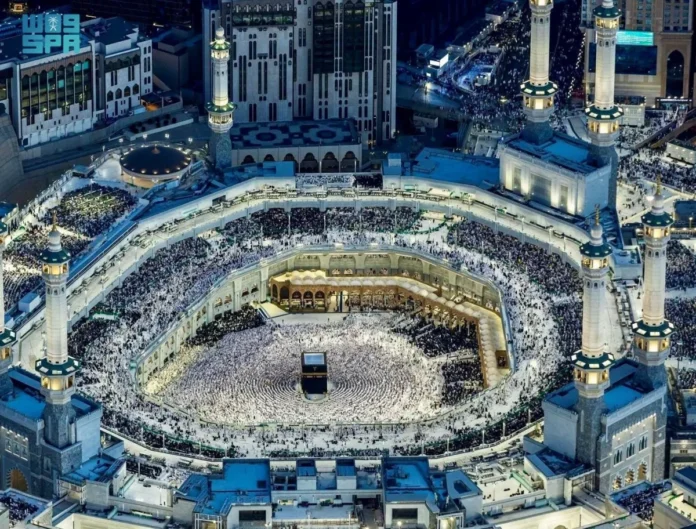
Saudi Arabia’s Deputy Emir of Makkah Prince Saud bin Mishaal has carried out an inspection tour of key facilities in and around the holy sites to review preparations ahead of the upcoming Hajj season.
The visit, which took place on Monday, included several strategic locations aimed at managing the large flow of pilgrims expected for the annual pilgrimage. Officials said the tour was part of ongoing efforts to ensure operational readiness and service efficiency during peak Hajj periods.
Prince Saud was accompanied by senior officials, including representatives from the Ministry of Hajj and Umrah, Makkah municipality, and public security authorities, reflecting the multi-agency coordination involved in managing the pilgrimage.
The inspection began at the Shumaisi checkpoint on the Makkah–Jeddah Expressway, where officials reviewed systems designed to facilitate the movement of pilgrims. The facility includes multiple traffic lanes and integrated services operated by several government entities to streamline entry procedures into Makkah.
The delegation was briefed on monitoring systems and reporting mechanisms used to manage traffic flow and respond to operational issues during the Hajj season.
The tour then continued to Mina, where Prince Saud visited Emergency Hospital 2, one of several medical facilities established to support pilgrims. Authorities said the hospital, along with field medical centres across the holy sites, forms part of a wider health system designed to handle large-scale emergencies and routine care during the pilgrimage.
Officials highlighted that the wider healthcare network includes dozens of field hospitals and urgent care centres, supported by thousands of medical staff and emergency response units. Ambulance fleets and medical evacuation aircraft are also deployed to ensure rapid response capabilities across the sites.
The delegation also inspected the Holy Sites Monitoring and Control Center, which oversees operational systems such as water distribution and real-time monitoring across multiple zones. The centre uses thousands of sensors and digital tools to support decision-making and maintain service continuity.
Another stop included the Tasleem Center, operated by Kidana Development Company, which provides digital services to improve administrative procedures and camp management. Officials said the platform integrates data systems, online services and security infrastructure to enhance efficiency during Hajj operations.
The visit concluded with a meeting of the Permanent Committee for Hajj and Umrah, where officials reviewed operational plans and coordination between different agencies involved in managing the pilgrimage.
The annual Hajj remains one of the largest religious gatherings in the world, and authorities in Saudi Arabia continue to expand infrastructure and digital systems to improve safety, mobility and service delivery for millions of pilgrims.
