
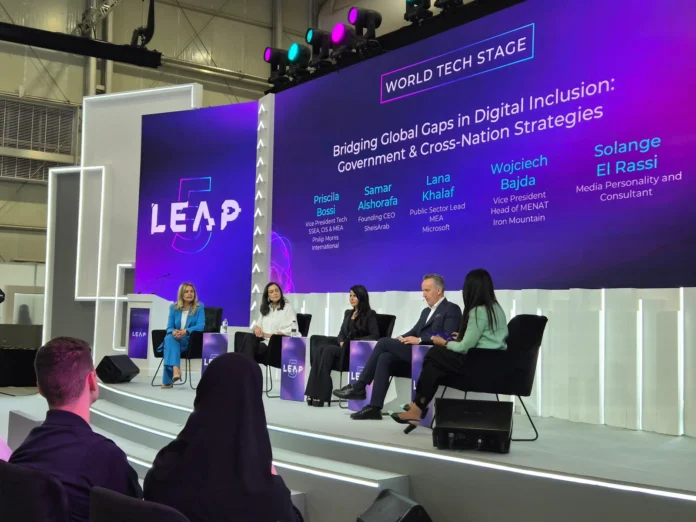
Saudi Arabia’s LEAP 2026 conference placed Digital inclusion at the center of discussions about artificial intelligence and technology access.
Government officials, technology executives, and social-sector leaders gathered in Riyadh to examine barriers limiting digital participation. Their discussion focused on infrastructure, accessibility, skills development, regulation, digital identity, and cooperation between countries.
The panel, titled “Bridging Global Gaps in Digital Inclusion,” examined how governments can coordinate with businesses. Speakers argued that technological progress should benefit communities regardless of geography, income, language, or existing digital capabilities.
Samar Al-Shorfa, founding chief executive of She is Arab, emphasized stronger partnerships between governments, companies, and social organizations. She explained that community-focused organizations often maintain direct relationships with groups that technology programs struggle to reach.
Furthermore, Al-Shorfa argued that governments should design technology policies around local circumstances instead of following identical international models. She pointed to Saudi Arabia’s Vision 2030 as an example of coordinated digital transformation and modernization.
Wojciech Bajda, vice president and head of MENAR at Iron Mountain, highlighted another opportunity for rapidly developing economies. He said emerging markets can avoid technical complications that countries accumulated through decades of fragmented digital development.
According to Bajda, older digital systems often create overlapping platforms, standards, and infrastructure that increase technical complexity. Therefore, countries undergoing rapid transformation can potentially build more coordinated systems from the beginning.
He also stressed that governments should consider cultural expectations, regulatory requirements, and local conditions when adopting emerging technologies. Meanwhile, Saudi Arabia’s investment in infrastructure, partnerships, and workforce development continues supporting its broader technology transformation.
Priscila Bossi, vice president of technology for SSEA, CIS and MEA at Philip Morris International, focused heavily on accessibility. She argued that companies should incorporate accessibility during product development rather than adding those features after launch.
Moreover, Bossi said technology should remain affordable and accessible while helping younger workers enter emerging employment fields. She argued that artificial intelligence could empower young professionals rather than simply replace opportunities across traditional employment sectors.
She also called for greater diversity across entrepreneurship and business while emphasizing responsible artificial intelligence deployment. Consequently, she stressed human oversight, critical thinking, and responsible decision-making as technology becomes increasingly integrated.
Lana Khalaf, public sector lead for MEA at Microsoft, identified several priorities needed for broader digital participation. These included digital identity, internationally recognized qualifications, artificial intelligence talent, regulation, reskilling, and cross-border cooperation.
Khalaf said people increasingly need digital identities and credentials that governments and organizations can recognize across national boundaries. Similarly, she highlighted reskilling and upskilling as essential measures as artificial intelligence changes workplace requirements.
She also suggested that AI could make public services more inclusive by supporting different languages and personalized educational experiences. As a result, governments could use emerging technology to reach communities previously excluded from conventional digital systems.
The panel also highlighted international examples where digital infrastructure helped expand access to financial and public services. Speakers referenced India’s digital identity infrastructure alongside Saudi Arabia’s Vision 2030 as notable transformation examples.
However, panelists stressed that infrastructure alone cannot guarantee meaningful participation in the digital economy. Instead, communities also need affordable access, practical skills, supportive policies, recognized credentials, and reliable digital systems.
Bajda additionally emphasized data quality as artificial intelligence adoption expands across governments and businesses. Since AI systems depend heavily on underlying information, inaccurate or inaccessible data could limit their effectiveness.
The discussions at LEAP 2026 therefore highlighted Digital inclusion as a broader economic and social priority. Governments and companies must increasingly combine technology investment with skills development, accessibility measures, and responsible regulatory frameworks.
Looking ahead, cross-border cooperation could become increasingly important as digital services, employment, and qualifications operate across national markets. Ultimately, Digital inclusion will depend on whether technological progress translates into practical opportunities for wider communities.
