
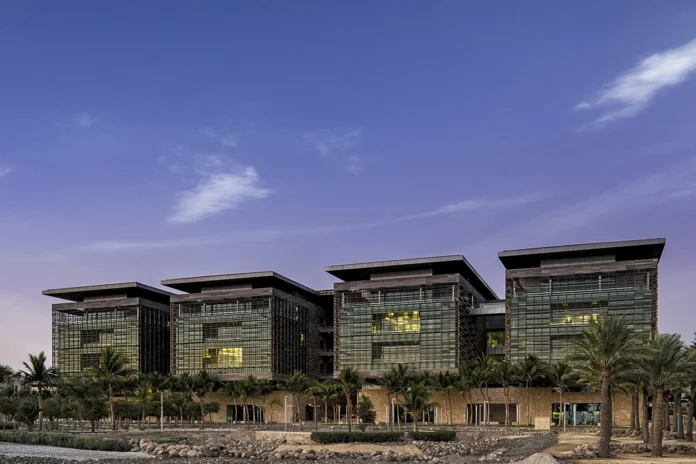
King Abdullah University of Science and Technology has secured the strongest Saudi representation among the 2026 Highly Cited Researchers. The university accounts for 16 researchers on Clarivate’s annual list, earning 20 recognitions across several scientific disciplines.
The results place KAUST at the forefront of Saudi Arabia’s research institutions. Moreover, the university ranks first among Arab universities by the number of recognised researchers this year.
Sixteen KAUST academics received recognition across eight research categories. Their fields include chemistry, engineering, environmental science, geosciences, mathematics, materials science and plant and animal science. The cross-field category also recognises research with influence across multiple disciplines.
Four researchers earned recognition in two separate categories, bringing KAUST’s overall total to 20. They include Professor Osman Bakr, whose work explores hybrid nanomaterials and their technological applications.
His research examines materials that could support developments in solar cells, batteries and photonic devices. Meanwhile, Professor Carlos Duarte studies global environmental changes and their effects on marine ecosystems.
Duarte also examines nature-based approaches to climate change and biodiversity loss. These research areas address major environmental challenges and contribute to discussions about protecting natural systems.
Another double-category recipient, Professor Stefaan De Wolf, focuses on advanced photovoltaic technologies. His research aims to improve solar-cell performance and increase the efficiency of solar energy systems.
Professor Yoshihide Wada also received recognition in two categories. His work investigates relationships between the biosphere, economic and social systems, and global resource limitations.
Beyond KAUST, five other Saudi institutions also appear in the 2026 rankings. Taif University received two recognitions in the cross-field category, reflecting research across different disciplines.
Princess Nourah bint Abdulrahman University secured two recognitions in plant and animal science and cross-field research. Additionally, the King Abdullah Petroleum Studies and Research Center received one cross-field recognition.
King Saud University earned one recognition in plant and animal science. King Fahd University of Petroleum and Minerals also secured one recognition in the cross-field category.
Together, these institutions bring Saudi Arabia’s representation to six organisations on the international list. KAUST nevertheless accounts for approximately 70 percent of the recognised Saudi-based researchers.
Clarivate publishes its Highly Cited Researchers list annually to highlight influential scientific and social science contributions. Its methodology identifies researchers whose publications demonstrate exceptional influence within their respective academic fields.
In particular, selected researchers have authored multiple papers ranking among the world’s top one percent most-cited publications. The assessment considers research published over an 11-year period through the Web of Science Core Collection.
The 2026 edition includes 7,090 researcher awards worldwide, recognising contributions across disciplines and countries. However, Clarivate does not rely on citation numbers alone when making its final selections.
Instead, its assessment combines quantitative indicators with qualitative analysis and expert judgment. This approach aims to provide a broader evaluation of research influence and academic contributions.
KAUST President Sir Edward Byrne described the results as a major achievement for the university. He highlighted the significance of reaching this level of international recognition less than two decades after its establishment.
Byrne also said the results reflect the strength of KAUST’s research community and its commitment to scientific excellence. He emphasised that researchers contribute to advancing knowledge and influencing discoveries worldwide.
The university also highlighted how researchers internationally use KAUST findings to develop further scientific work. Consequently, the recognition reflects the institution’s growing contribution to global research and scientific discussions.
The latest results reinforce Saudi Arabia’s presence in international academic research. They also highlight KAUST’s leading position among regional institutions in the 2026 Highly Cited Researchers rankings.
