
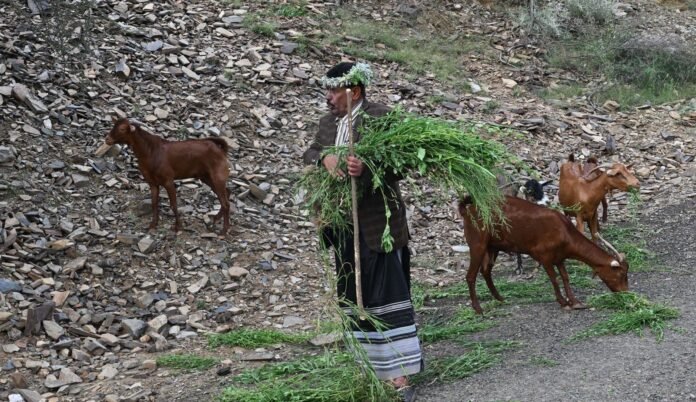
A traditional herder’s call continues to preserve Jazan’s pastoral heritage, connecting generations through livestock herding and local ecological knowledge. Known as Tarwi’at Al-Ra’i, this distinctive oral practice remains part of daily life across southwestern Saudi Arabia.
Across Jazan’s mountain valleys, rocky slopes and coastal plains, herders use rhythmic calls to communicate with their animals. The sounds carry practical meaning, helping shepherds gather livestock, guide movement and manage herds across challenging landscapes.
The tradition also reflects the region’s long relationship with livestock farming and seasonal land use. According to regional figures from the Ministry of Environment, Water and Agriculture, Jazan has more than 7.8 million livestock animals. A total of 23,405 licensed herders manage these animals throughout the region.
Sheep account for the largest share, numbering more than four million. Goats follow with over 3.6 million, while the region also has 130,161 cattle and 79,478 camels.
However, successful herding requires considerably more than providing animals with food and water. Pastoralists must understand changing grazing routes, local vegetation, seasonal water supplies and animal behaviour. They also need physical stamina to navigate the steep slopes and rugged terrain common throughout southwestern Saudi Arabia.
Within this environment, Tarwi’at Al-Ra’i serves as a practical communication system. Herders use different tones and rhythmic patterns to deliver particular signals, depending on the situation. For example, morning calls can help bring scattered animals together before they move towards fresh grazing areas.
Later in the day, other vocal patterns help herders gather their livestock and guide them home before darkness. Over time, animals learn to recognise the distinctive sound of their handler’s voice and respond to familiar commands.
This knowledge develops through experience and often passes from one generation to another. As a result, the practice supports livestock production while helping rural families maintain skills closely connected to their livelihoods.
In the rocky gorges of Balghazi, within Al-Aidabi governorate, local heritage advocate Mohammed Al-Ghazwani works to keep this tradition alive. He practises the calls and documents their use, allowing the sounds to continue reaching audiences beyond the immediate herding community.
For Al-Ghazwani, the practice represents much more than a method for managing animals. He views it as an intangible cultural asset that preserves generations of knowledge about the natural environment.
Moreover, the calls reflect how pastoral communities have adapted to Jazan’s geography over centuries. Their sounds carry practical information while expressing a cultural relationship between herders, livestock and the land.
Preserving Tarwi’at Al-Ra’i therefore helps protect both traditional skills and the memories associated with rural life. Documentation and continued practice can also help younger generations understand the knowledge that earlier herders developed through daily experience.
As modern lifestyles reshape communities, such oral traditions offer a valuable link to regional history. In Jazan, the herder’s call continues to unite practical livestock management with cultural identity and environmental awareness.
Through his work, Al-Ghazwani helps ensure that Tarwi’at Al-Ra’i remains recognised as part of the region’s living heritage. Its continued presence demonstrates how an everyday farming practice can preserve cultural knowledge while supporting the livelihoods of pastoral communities.
