
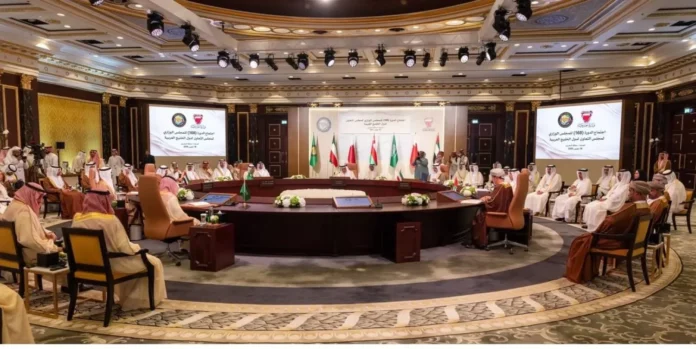
Gulf solidarity with Saudi Arabia took center stage as foreign ministers condemned Houthi attacks on the Kingdom. During a meeting in Bahrain on Sunday, officials supported Saudi Arabia’s right to defend itself against threats to its security. They also discussed regional tensions, maritime safety, and the need to protect civilian infrastructure.
The discussions took place during the 168th Ministerial Council of the Gulf Cooperation Council (GCC). Ministers reviewed developments in Yemen and considered the wider implications of escalating regional tensions. In addition, they expressed concern about threats to freedom of navigation across the Arabian Gulf and Red Sea.
Following the meeting, Gulf officials held the ninth joint ministerial meeting of the Gulf-Russian Strategic Dialogue. The talks aimed to strengthen relations between Gulf states and Russia while expanding cooperation across several fields. GCC Secretary-General Jasem Albudaiwi said both sides would exchange views on shared concerns and explore opportunities for closer coordination.
Bahrain’s Foreign Minister Abdullatif bin Rashid Al Zayani addressed the ministerial council and emphasized regional unity. He reaffirmed Gulf support for Saudi Arabia’s right to self-defense under Article 51 of the United Nations Charter. He also described the Kingdom’s security as closely connected to the security of every GCC member.
Al Zayani condemned Houthi attacks on Saudi territory, particularly assaults targeting civilians and civilian facilities. He cited an attack on King Khalid International Airport that reportedly killed 14 civilians and injured more than 300. He argued that attacks against civilian aviation violate international law and the Chicago Convention.
Furthermore, Bahrain reiterated its support for Saudi Arabia as the Kingdom confronts continuing security threats. Al Zayani stressed that Gulf countries share an interest in protecting civilian lives and maintaining regional stability. His remarks reflected the council’s broader position that attacks against civilian infrastructure demand a coordinated response.
Albudaiwi also condemned Houthi attacks, describing them as deliberate actions that endanger human life and public safety. He warned that repeated assaults against airports, energy infrastructure, and other civilian facilities could deepen regional instability. Moreover, he highlighted the risks facing residents, travelers, and workers when armed attacks threaten essential services.
The GCC secretary-general called for meaningful international action to stop the attacks and hold those responsible accountable. He argued that continued assaults undermine security and create additional risks for countries across the region. Gulf solidarity with Saudi Arabia, he indicated, remains central to efforts to address these threats.
Albudaiwi also raised concerns about attacks attributed to Iran against GCC member states. He said such actions violate national sovereignty and territorial integrity while threatening regional security. Additionally, he criticized Iran’s activities affecting maritime navigation through the Strait of Hormuz.
He warned that using the strategic waterway to exert pressure could disrupt international trade and global energy supplies. Consequently, the GCC emphasized the importance of protecting safe passage through the strait without restrictions or threats. Albudaiwi also called on Iran to comply with international law and the United Nations Charter.
The secretary-general further urged full implementation of United Nations Security Council Resolution 2817. He stressed that regional stability depends on respect for sovereignty, protection of civilians, and secure maritime routes. The council’s discussions therefore linked Gulf solidarity with Saudi Arabia to wider concerns about regional security and international navigation.
The meetings in Bahrain combined condemnation of recent attacks with diplomatic efforts to strengthen regional and international partnerships. Gulf ministers reaffirmed their support for Saudi Arabia while emphasizing cooperation with Russia and other international partners. Their statements underscored the GCC’s focus on protecting member states, civilian infrastructure, and vital trade routes.
