
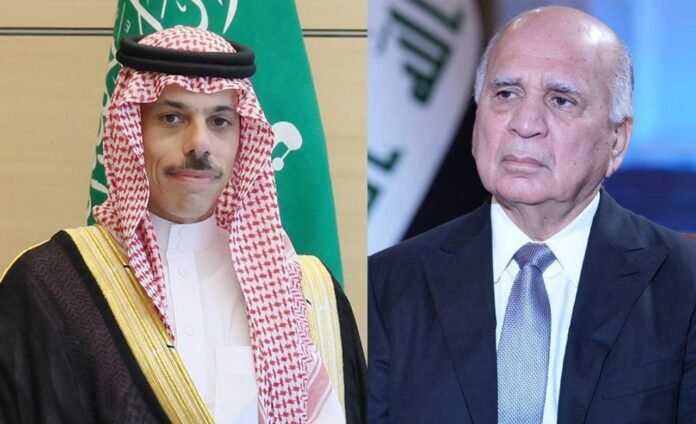
Iraqi and Saudi foreign ministers called for regional de-escalation during a phone discussion focused on preventing further tensions. Iraqi Foreign Minister Fuad Hussein spoke with Saudi Foreign Minister Prince Faisal bin Farhan Tuesday. The two officials emphasized peaceful approaches for addressing disagreements between countries across the region. Their discussion also highlighted the importance of maintaining communication during heightened regional uncertainty.
Hussein stressed the need for continued coordination between Baghdad and Riyadh during the conversation. He also urged both sides to work together to prevent existing tensions from spreading across neighboring countries. Furthermore, the Iraqi minister emphasized peaceful dialogue as the preferred approach for resolving regional disputes. Consequently, the discussion reflected broader efforts to contain tensions through diplomatic engagement and direct communication.
The conversation came alongside a renewed Saudi invitation for Prime Minister Ali al-Zaidi to visit Riyadh. Saudi intelligence chief Khalid bin Ali al-Humaidan previously extended the invitation on August 7. The proposed visit had initially received plans for late July, according to the reported timeline. However, authorities later cancelled the trip following significant regional security developments involving Iran-aligned groups.
The cancellation followed joint US-Saudi airstrikes against Iran-aligned armed groups inside Iraq on July 29. Those strikes reportedly killed more than 20 fighters affiliated with Iraq’s Popular Mobilization Forces. The incident subsequently added further complications to relations involving Baghdad, Riyadh, and Washington. Nevertheless, Saudi Arabia renewed its invitation, signaling continued interest in maintaining high-level communication with Iraq.
The renewed invitation also comes as Baghdad seeks to strengthen diplomatic channels with regional governments. At the same time, Saudi Arabia has continued emphasizing dialogue and coordination with neighboring states. Therefore, the proposed visit could provide an opportunity to address unresolved concerns through direct political discussions. It could also help both governments examine broader security developments affecting the region.
For Iraq, maintaining balanced relations with neighboring Arab states remains an important diplomatic objective. Meanwhile, Saudi Arabia has continued developing closer political and economic engagement with Baghdad. As a result, direct discussions between senior officials could help reduce misunderstandings surrounding regional security developments. Moreover, sustained communication could support efforts to prevent individual conflicts from producing wider regional consequences.
Regional de-escalation therefore remains an important element of the current diplomatic engagement between Baghdad and Riyadh. Both governments face a complicated regional environment involving competing security interests and shifting alliances. Accordingly, maintaining communication could help officials manage disagreements before they develop into broader confrontations. The renewed invitation also indicates that diplomatic channels remain open despite recent tensions.
The two foreign ministers’ conversation highlights the importance of continued coordination between Iraq and Saudi Arabia. Furthermore, peaceful dispute resolution could provide both countries with greater space for addressing sensitive regional issues. The proposed visit to Riyadh could become another step toward strengthening bilateral political communication. However, the timing and final arrangements for the visit remain subject to further coordination between both governments.
