
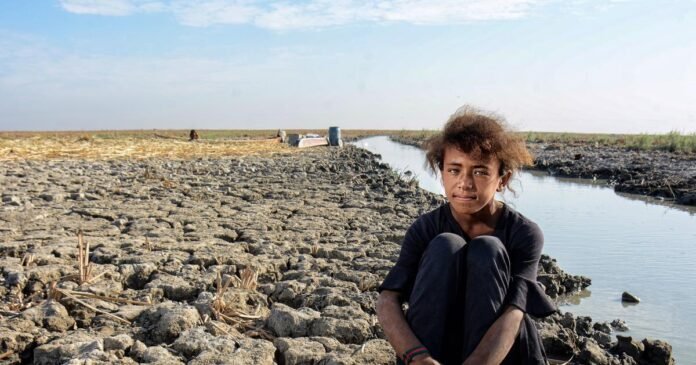
Iraq continues to face severe environmental challenges, and climate pressure is rising across several provinces. Thousands of families now leave their homes each year because drought, desertification, and shrinking water levels threaten their survival. This growing climate strain pushes Iraq toward a critical stage, and policymakers warn that immediate action is necessary because climate pressure is rising.
More than 17,000 families relocated over the past five years due to worsening conditions. The migration ministry confirmed that 17,365 families moved since 2021. Dhi Qar recorded the highest displacement with 9,525 families. Diwaniyah followed with 2,823 families, while Muthanna reported 1,668 families. Maysan documented 1,643 families, and Basra saw 951 families leave their homes. Najaf added 742 displaced families, while Wasit recorded 13. These figures show how fast the crisis spreads across the country.
Local officials describe worrying scenes in Dhi Qar. Large sections of the northern wetlands fully dried up. Teams tried to revive some areas with water from the Tigris River. However, many marshes remain beyond rescue. Last year, water levels in Dhi Qar marshes dropped to half a meter. This year, experts expect an even sharper decline since high temperatures accelerate evaporation.
Recent census results show Dhi Qar now hosts more than 2.3 million people. That population depends heavily on agriculture, yet farmland continues to shrink. Iraq risks losing 96.5 million dunams to desertification. Only 13.5 million dunams remain suitable for farming. Government data also show that only 1.4 percent of Iraq is green or forested.
Officials from the environment ministry stress the need for fast intervention. They say many lands lost fertility because of water scarcity. Additionally, new national plans aim to expand green zones and reclaim damaged areas. These plans support the wider government initiative to plant more than eight million trees. Agriculture authorities already planted more than 1.3 million seedlings across different provinces.
Committees from several ministries now assess fully damaged lands and areas at risk. The government plans long-term mitigation steps after the assessment ends. Officials also prepare the required budget for these programs.
Environmental experts explain that natural and human factors both worsen desertification. High temperatures, low rainfall, and declining groundwater levels accelerate land loss. Meanwhile, poor farming practices, urban expansion, and population growth intensify the strain.
Experts warn that desertification threatens food security and increases dust storms. They say Iraq must act now because climate pressure is rising and continues to reshape the country’s future.
