
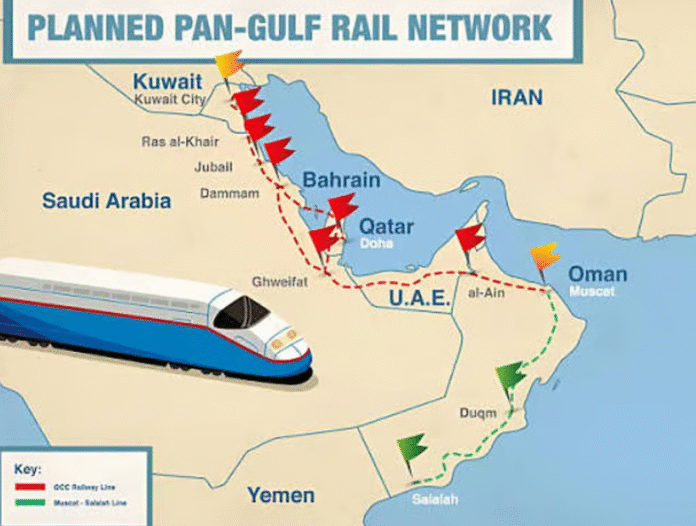
Gulf countries are moving closer to a fully integrated rail network, emphasizing cross-border rail connectivity across the GCC. Moreover, member states are signing agreements and accelerating projects to link major cities, airports, and ports. Experts believe that, as a result, cross-border rail connectivity will transform travel, trade, and tourism in the region.
Etihad Rail in the UAE already runs freight services and will launch passenger operations in 2026. In addition, the line will connect 11 cities, offering a modern alternative to road travel. Saudi Arabia operates networks like Saudi Arabia Railways (SAR) and the Haramain High-Speed Rail, which also support domestic and regional mobility.
Several major rail projects are shaping the future of Gulf travel. For example, Saudi Arabia and Qatar agreed to build a high-speed electric railway linking Riyadh and Doha. Trains will travel over 300 km/h, covering 785 kilometres. The line will pass through Riyadh, Hofuf, and Dammam, while also connecting King Salman International Airport with Hamad International Airport. This project will reduce travel time and boost trade and tourism between the two countries.
The UAE–Oman Hafeet Rail connects Al Ain with Oman’s Sohar Port. The 238 km line, valued at roughly USD 2.5 billion, will carry passengers at speeds up to 200 km/h and handle freight operations. Furthermore, Hafeet Rail will become the region’s first fully integrated cross-border railway, strengthening cross-border rail connectivity.
Saudi Arabia and Kuwait plan a 650 km railway link, starting construction in 2026 and finishing by 2028. The line will run from Al Shadadiya in Kuwait’s Al Farwaniya governorate to Riyadh, transporting passengers and freight efficiently. Similarly, the King Hamad Causeway project will link Bahrain and Saudi Arabia with 57 km of railway running alongside four road lanes. The project will connect Bahrain’s King Hamad International Station with Dammam railway station, integrating Bahrain’s domestic transport with the GCC network.
By the end of the decade, residents and visitors will travel easily between major cities, ports, and airports across the Gulf. Cross-border rail connectivity will revolutionize mobility, strengthen trade, and promote regional cooperation.
