
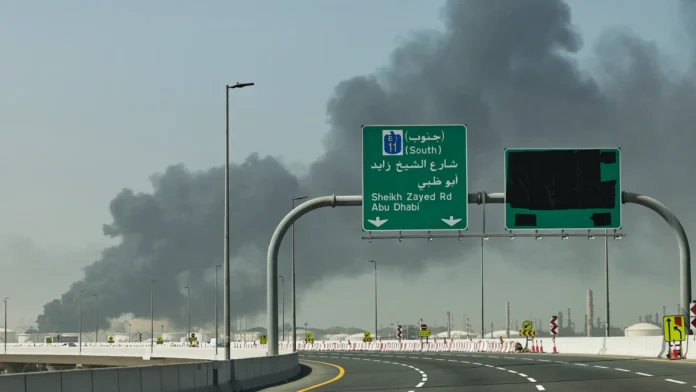
UAE defensive stance strengthened this week as authorities considered new measures against Iranian strikes. Moreover, UAE defensive stance reflects the country’s determination to protect civilians and critical infrastructure. Analysts note that UAE defensive stance will guide future military and security decisions in the Gulf.
The United Arab Emirates has faced repeated Iranian missile and drone attacks targeting its civilian infrastructure and oil facilities. Dubai and other emirates have sustained damage, including fires at Jebel Ali port and strikes on luxury hotels. Officials report that Iran launched 186 ballistic missiles and over 800 drones, with most intercepted but some causing casualties.
Anwar Gargash, foreign policy adviser, emphasized that Iran’s attacks miscalculated regional dynamics. He noted these actions isolate Iran and highlight its missile program as a destabilizing force. In addition, he stressed the UAE’s right to respond firmly while avoiding unnecessary escalation.
The Emirati Defense Ministry stated that the country retains full authority to act in self-defense. Authorities have not yet altered their defensive posture but are closely monitoring the situation. They confirmed that three foreign nationals died and about 70 individuals were wounded in recent attacks.
Since the war began, Iranian strikes have expanded across Gulf states, hitting Kuwait, Bahrain, Qatar, Oman, and Saudi Arabia. The attacks have also disrupted energy production, prompting countries like Qatar to suspend most natural gas operations temporarily.
Regional observers indicate that other Gulf nations, including Saudi Arabia, may consider military responses. Consequently, coordination among Gulf states and allies is likely to increase. Officials highlight that collective defense remains crucial to deter further aggression.
In addition, the ongoing conflict has involved U.S. and Israeli operations. Operation Epic Fury, led by U.S. and Israeli forces, targets Iranian positions and aims to last several weeks. These actions further complicate the regional security landscape and influence the UAE’s strategic calculations.
Overall, UAE defensive stance aims to safeguard territory, citizens, and residents. Authorities continue to balance caution with preparedness while maintaining regional alliances. Analysts suggest that this measured approach strengthens deterrence and protects national interests effectively.
