
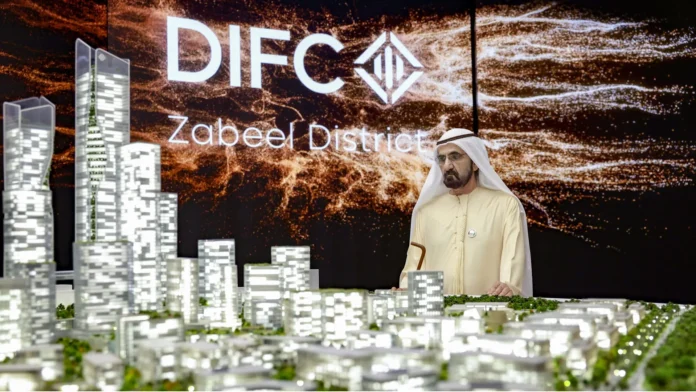
Dubai moved forward with a major financial expansion on Tuesday, reinforcing its status as a global economic hub. Authorities announced the second phase of the Dubai International Financial Centre, signaling long-term confidence in economic growth. The project carries a total value of Dh100 billion.
Officials said the new phase will rise in the Zabeel District. Moreover, the expansion supports Dubai’s ambition to rank among the world’s top four financial centers. As a result, planners designed the project to attract global investment and advanced industries.
During the announcement, leaders highlighted ongoing economic transformation across the emirate. They explained that recent expansions aim to deliver strong development gains. Additionally, they stressed that Dubai’s financial future continues to strengthen daily.
According to details shared publicly, the project will significantly expand education and innovation facilities. The DIFC Academy will grow to serve 50,000 students each year. Meanwhile, a digital economy hub will span one million square feet.
This innovation hub will host nearly 6,000 companies. Furthermore, it will accommodate about 30,000 artificial intelligence specialists. Consequently, Dubai aims to position itself at the center of emerging technologies.
In addition, planners included an arts and culture center within the project. A modern conference venue will also form part of the development. Officials confirmed that advanced digital infrastructure will support global financial firms.
Overall, the expansion will cover 17 million square feet of gross floor area. It will accommodate nearly 125,000 professionals. Therefore, the project ranks among Dubai’s largest commercial developments.
Since its launch in 2004, DIFC has grown into a global financial magnet. It attracts banks, fintech firms, and professional service providers. Moreover, its legal and regulatory framework supports business confidence.
The district operates through three independent institutions. These include the DIFC Authority, the financial regulator, and the courts system. Together, they ensure clarity, efficiency, and legal certainty.
Looking ahead, the new expansion will connect to the planned Dubai Loop transport system. This underground network will enable high-speed travel across the city. Additionally, the area will support flying taxis and autonomous vehicles.
Meanwhile, Dubai continues a broader infrastructure drive. Another DIFC expansion will add 600,000 square feet of office space soon. Consequently, demand for premium commercial property remains strong.
The city has also experienced a property surge since the pandemic. Foreign investment and residency reforms fueled population growth. Government figures show Dubai’s population exceeded four million last year.
By late November, DIFC hosted more than 8,000 active registered companies. Hedge fund registrations more than doubled since 2024. This trend further supports Dubai’s image as a global economic hub.
Officials confirmed that the first phase of the new project will arrive in 2030. It will include office towers, residential buildings, a hotel, and an AI campus. Financing will rely on internal resources and future revenues.
Ultimately, the expansion reflects Dubai’s long-term vision. Authorities continue to prioritize innovation, finance, and connectivity. Through strategic investment, the emirate strengthens its role as a global economic hub.
