
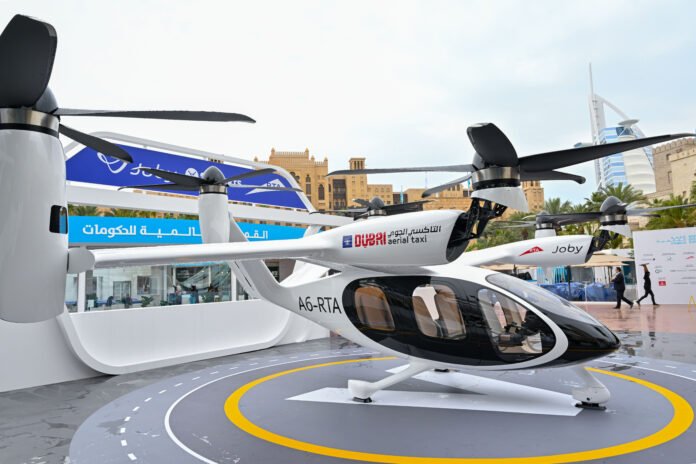
Dubai is moving closer to a new chapter in urban transportation driven by electric aviation. Accordingly, authorities confirmed plans to introduce commercial air taxi services before the year ends. From the start, Dubai air taxi commercial launch frames the city’s wider strategy for smarter and faster mobility.
Therefore, Dubai’s Roads and Transport Authority expects initial operations to begin within months. Officials stressed that the timeline aligns with long-term transport modernization goals. As a result, air taxis will integrate into Dubai’s existing public transport network.
Earlier progress helped accelerate confidence in the project’s feasibility. In June 2025, Joby Aviation completed its first successful test flight in Dubai. Consequently, the flight validated performance under local climate and urban conditions.
Moreover, the test confirmed regulatory readiness and operational coordination. Because of this success, authorities moved forward with commercialization planning. In turn, Dubai strengthened its position as a global transport innovation hub.
Joby Aviation developed the aircraft as a fully electric vertical take-off and landing vehicle. Therefore, the air taxi can operate without traditional runways. This capability allows flexible deployment across dense urban environments.
In addition, the aircraft can travel up to 160 kilometers on a single charge. At the same time, it can reach speeds of up to 320 kilometers per hour. As a result, passengers could reduce long commutes to minutes.
Environmental considerations also shape the project’s appeal. Notably, the air taxi produces zero operating emissions. Furthermore, its design minimizes noise, making it suitable for city operations.
Because of these features, Dubai sees air taxis as a sustainable mobility solution. Consequently, the project supports broader climate and clean energy objectives. This alignment strengthens long-term policy support.
In early 2024, Joby Aviation secured exclusive operating rights in Dubai. Accordingly, the agreement grants the company six years to run aerial taxi services. This exclusivity provides operational certainty and investment stability.
Meanwhile, the Roads and Transport Authority continues infrastructure preparation. Specifically, planners are identifying landing locations and charging facilities. Therefore, deployment will prioritize safety, efficiency, and passenger accessibility.
In parallel, regulators are developing operational frameworks. These rules will govern flight paths, safety standards, and airspace coordination. As a result, authorities aim to ensure smooth integration with existing aviation traffic.
Public interest in the project continues growing steadily. Consequently, officials expect strong demand once services begin. This demand could reshape daily commuting patterns across the city.
Ultimately, the Dubai air taxi commercial launch reflects a broader vision for future transport. The initiative blends innovation, sustainability, and urban planning. Through this approach, Dubai continues redefining how cities move.
As commercial operations approach, attention will focus on execution and scalability. Nevertheless, the Dubai air taxi commercial launch already signals a major shift in urban mobility thinking.
