
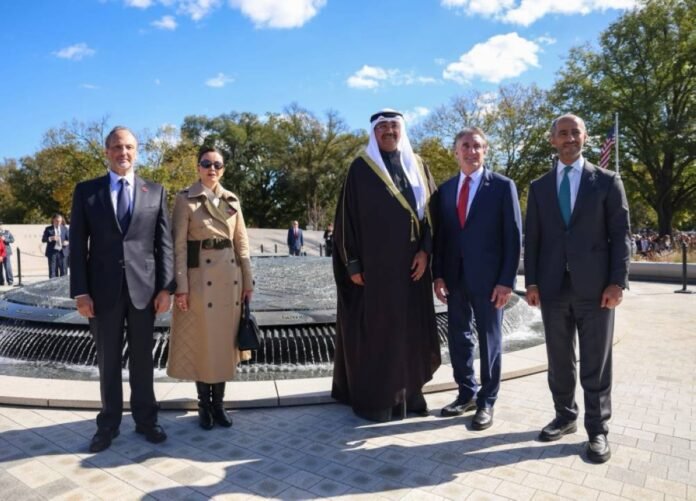
The Desert Storm Memorial opened in Washington on Saturday, honoring the international coalition that helped liberate Kuwait in 1991. The ceremony brought together Kuwaiti officials, American representatives, diplomats, military veterans and their families. The new landmark recognizes the sacrifices of troops from more than 30 countries during the Gulf War.
Kuwait’s Defense Minister Sheikh Abdullah Ali Abdullah Al-Salem Al-Sabah attended the inauguration alongside Kuwait’s ambassador to the United States, Sheikha Al-Zain Al-Sabah. Their presence highlighted Kuwait’s appreciation for the countries that supported its liberation. Meanwhile, American officials and representatives from coalition nations gathered to mark the memorial’s completion on the National Mall.
According to Kuwait’s Ministry of Defense, the minister praised the courage and sacrifices of coalition forces. He described the memorial as a lasting symbol of international cooperation and solidarity. Furthermore, he emphasized the importance of protecting this shared history and ensuring future generations understand its significance.
During the ceremony, Sheikha Al-Zain expressed Kuwait’s enduring gratitude to those who responded to the call for service. She said their contributions would remain part of Kuwait’s national memory. She also highlighted the longstanding strategic partnership between Kuwait and the United States.
Addressing representatives from coalition countries, the ambassador emphasized that Kuwait’s liberation represented a collective achievement. She noted that the relationships formed during the conflict continue to connect participating nations. Moreover, she stressed that sovereignty, international law and territorial integrity remain essential principles more than 35 years later.
Scott Stump, chief executive of the National Desert Storm Memorial Association and a Marine Corps Reserve veteran, also addressed the gathering. He thanked Kuwait and the Kuwait Banking Association for supporting the project’s completion. Stump estimated that between five million and six million people could visit the memorial annually. Consequently, he said, the site would help preserve the story for generations.
Former congressman and Army veteran Dr. Phil Roe also welcomed Kuwait’s presence at the ceremony. He observed that the memorial tells the story of both Kuwaitis and Americans. His remarks reinforced the shared significance of the campaign and its lasting place in both countries’ histories.
The memorial’s design incorporates elements inspired by Kuwait’s landscape and the military operation that liberated the country. Skip Graffam, research director at landscape architecture firm OLIN, explained that the design creates an oasis framed by two landforms resembling Kuwait’s Burgan sand dunes.
At the site, the Storm Wall features sculptures by artist Emily Bedard that portray the conflict, from the coalition buildup through Kuwait’s liberation. In addition, curved pathways reflect the “left hook” maneuver used during the ground offensive. These design choices connect the memorial’s physical layout with the military campaign it commemorates.
Two stainless-steel artworks by Robert Eccleston represent the United States and Kuwait. Elsewhere, the Inscription Wall offers a quieter space honoring those who served. At the memorial’s center, a Unity Shield symbolizes the coalition nations, surrounded by green spaces and a fountain.
The Desert Storm Memorial provides a permanent place to remember the international effort that restored Kuwait’s sovereignty. Through its architecture, inscriptions and sculptures, the site connects military history with the principles of cooperation and national independence. Its opening also renews attention to the sacrifices made by service members and the enduring relationships formed during the 1991 liberation.
