
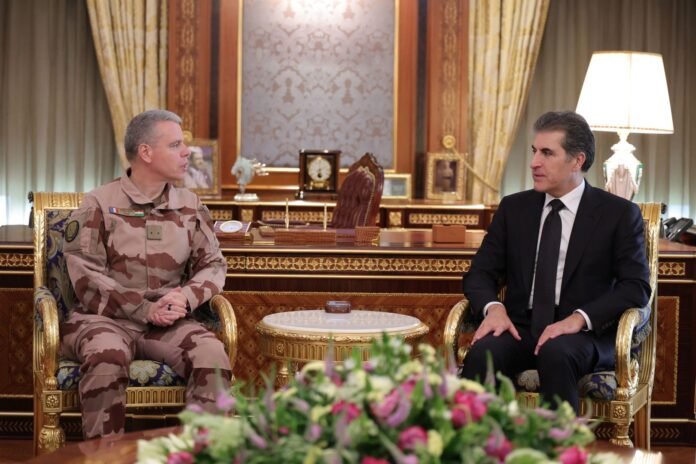
Global Coalition presence in Kurdistan shaped high-level talks in Erbil amid renewed regional security concerns. Regional leaders continue to track extremist threats across Iraq and Syria. Therefore, diplomatic engagement intensified following recent military developments. Security coordination now stands at the center of regional priorities.
During a meeting in Erbil, Nechirvan Barzani received Francois Tricot, Paris’s representative to the Global Coalition. The discussion focused on security cooperation and counterterrorism efforts. Moreover, both sides reviewed developments affecting Iraq and the Kurdistan Region. Officials also examined the coalition’s evolving mission.
According to a statement from the Kurdistan Region Presidency, the meeting addressed relations with France. Leaders discussed political and security conditions across the region. Furthermore, they examined the ongoing threat posed by ISIS cells. Coordination between Erbil and Baghdad remained a key topic.
Barzani focused on continued cooperation with international partners. He highlighted the importance of joint efforts against terrorism. In addition, he expressed appreciation for France’s ongoing support. This support includes assistance to security forces across Iraq.
Tricot reaffirmed France’s commitment to cooperation. He stressed continued backing for Kurdistan Region institutions. He also highlighted support for Peshmerga forces. Therefore, both sides stressed shared responsibility for regional stability.
The meeting also covered developments in Syria. Leaders discussed broader regional shifts and their security impact. Consequently, both sides exchanged assessments on cross-border threats. These discussions reflected growing concern about militant activity.
Recent events in Syria heightened those concerns. An attack in Palmyra killed two American soldiers and a civilian interpreter. Several others sustained injuries during the assault. Although ISIS issued no claim, officials suspect extremist involvement.
Following the attack, Washington signaled a firm response. The incident underscored persistent extremist risks in the region. Therefore, coalition coordination regained urgency. Regional leaders now seek preventive strategies.
Meanwhile, security dynamics inside Iraq continue to shift. The Global Coalition concluded its mission in federal Iraq. As a result, coalition forces relocated entirely to the Kurdistan Region. Global Coalition presence in Kurdistan now defines the new operational posture.
According to Iraqi military officials, only a small liaison team remains in Baghdad. These personnel handle logistics and diplomatic coordination. Consequently, Erbil now hosts coalition forces exclusively. This move reflects strategic recalibration rather than disengagement.
Officials believe the relocation improves operational flexibility. The Kurdistan Region offers logistical advantages and stability. Moreover, existing cooperation frameworks support coordination. These factors influenced the coalition’s decision.
Regional leaders continue consultations with international partners. They aim to prevent extremist regrouping. Therefore, intelligence sharing and joint planning remain priorities. Security officials stress readiness over reaction.
France has supported Iraqi and Kurdish forces since 2014. That cooperation began during the fight against ISIS expansion. Today, the mission focuses on containment and prevention. Global Coalition presence in Kurdistan plays a central role in this strategy.
As regional tensions persist, diplomatic engagement continues. Leaders emphasize cooperation, vigilance, and coordination. These efforts seek to protect stability across northern Iraq and beyond.
