
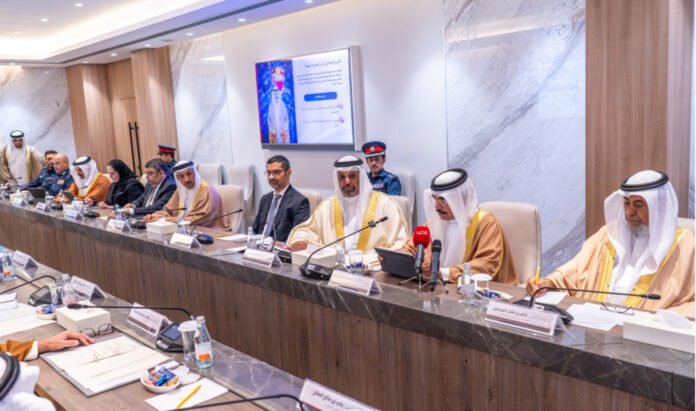
Bahrain Readiness remains a central focus as the kingdom’s legislative and executive authorities review measures following Iranian attacks. Senior officials, lawmakers and Shura Council members met to assess national response measures. They reviewed efforts to protect citizens and residents while maintaining essential services and emergency capabilities. The meeting also examined supply continuity, emergency responses and repairs following damage caused by the attacks.
National Assembly and Parliament Speaker Ahmed Al Musallam and Shura Council Chairman Ali Saleh Al Saleh chaired the meeting. Interior Minister General Shaikh Rashid bin Abdulla Al Khalifa led the government delegation during the discussions. Officials examined coordination between government institutions and emergency agencies throughout the continuing regional conflict. They also discussed additional measures needed to maintain public safety and essential services.
General Shaikh Rashid said Bahrain developed its emergency preparedness through planning and institutional development spanning 25 years. He said government agencies worked collectively and proactively while monitoring local and regional developments. According to the minister, those efforts focused on protecting citizens and residents while maintaining essential services. He also highlighted the importance of continued coordination as regional security conditions remain uncertain.
The minister said the Bahrain Defence Force had responded to more than 1,000 Iranian missile and drone attacks. Military, security and civilian agencies coordinated their responses through established national decision-making mechanisms. These mechanisms include the Supreme Defence Council, Cabinet and Coordination Committee. They also include the Civil Defence Council and National Civil Emergency Management Committee.
Authorities activated emergency operations rooms and implemented evacuation plans during the attacks. Bahrain prepared 35 shelters across the kingdom, with capacity for more than 40,000 people. These facilities formed part of broader emergency measures designed to support residents during potential disruptions. Authorities also continued coordinating evacuation arrangements alongside other emergency response operations.
Medical and ambulance services also moved to heightened readiness during the period. At the same time, authorities strengthened cyber-response capabilities and monitored important supply chains. Government agencies maintained strategic stocks to support continuity of essential supplies. These measures formed part of the wider national response to potential disruptions.
Electronic warning systems also played an important role during the emergency response. The systems provided alerts to citizens and residents as authorities monitored developments. Security communications, civil defence teams and emergency medical services also remained mobilised. Consequently, several government bodies worked simultaneously to maintain emergency response capabilities.
Bahrain Readiness also involves maintaining coordination between military, security and civilian institutions. Officials stressed that the continuing conflict requires authorities to maintain preparedness rather than reduce emergency measures. General Shaikh Rashid said the circumstances require continued coordination and additional steps. Authorities therefore continue reviewing their procedures as regional developments evolve.
The joint meeting provided officials with an opportunity to assess existing response arrangements. It also allowed authorities to review how different institutions managed their responsibilities during the attacks. Furthermore, officials considered measures aimed at maintaining services and protecting critical supplies. The discussions covered both immediate emergency responses and longer-term preparedness requirements.
The continued operation of emergency systems remains important as regional tensions affect security conditions. Authorities have therefore maintained coordination between different agencies responsible for national emergency management. These arrangements allow officials to monitor developments and respond through established institutional channels.
Bahrain Readiness now remains linked to continued planning, coordination and emergency preparedness across government institutions. Officials have emphasised maintaining essential services while preparing for possible further developments. The measures include shelters, medical services, warning systems, supply monitoring and cyber-response capabilities. Together, these systems support the kingdom’s broader emergency management framework.
The authorities’ review also highlights the role of long-term institutional planning in emergency preparedness. General Shaikh Rashid attributed the current capabilities to decades of planning and organisational development. He said agencies built their response systems through continuous monitoring and coordinated preparation. The latest meeting focused on maintaining those capabilities during the ongoing regional situation.
Officials continue to assess developments and determine whether additional measures may become necessary. Meanwhile, emergency agencies remain prepared to respond through established national coordination mechanisms. The authorities have also maintained communication systems designed to keep citizens and residents informed.
The meeting ultimately reinforced the importance of sustained preparedness across Bahrain’s government institutions. Authorities continue focusing on public safety, essential services and coordinated emergency responses. As regional developments remain fluid, government agencies are maintaining their readiness and reviewing response measures.
