
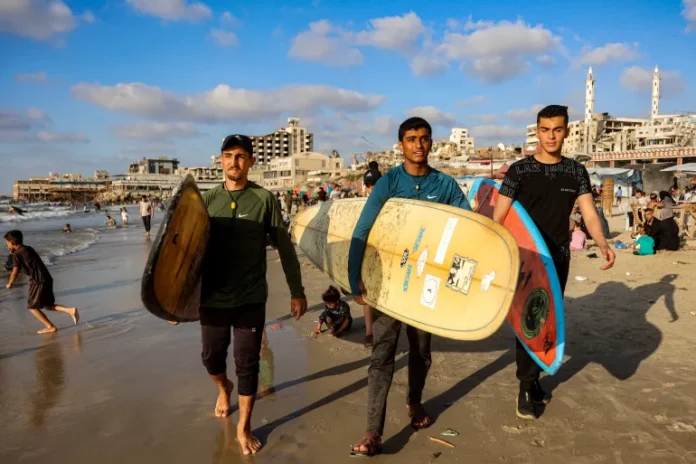
Along the shores of Gaza City, a small group of surfers continues to carry their boards past tents and damaged buildings, heading into the Mediterranean Sea in search of brief moments of relief from the realities of war.
Despite the ongoing conflict and persistent safety risks, the surfers paddle out into waters that have become both a refuge and a place of uncertainty.
For 23-year-old Tahseen Abu Assi, surfing is more than a sport. It is a way to cope with life under extreme conditions. He describes the feeling of catching a wave as something that offers rare comfort amid the instability on land.
Many of the surfers learned the sport from family members and have continued despite years of hardship, displacement, and shortages of basic equipment.
Conditions in Gaza have made even maintaining the sport difficult. Essential supplies such as surf wax are largely unavailable, forcing surfers to improvise with alternatives such as candle wax to keep their boards usable.
Equipment is often old and scarce, with some boards used for decades and carefully preserved due to the difficulty of replacing them.
Before the war, local surfers say there were larger groups and more activity along the coast. Now, only a handful remain, with many forced to stop due to damage, displacement, and lack of resources.
Even at sea, however, danger is never far away. Fishermen and civilians have reported incidents of gunfire near coastal waters in recent months, underscoring the risks faced even outside the immediate conflict zones.
For those who continue, the Mediterranean remains one of the few remaining spaces of escape. Despite uncertainty, they say the ocean offers a rare sense of freedom in an otherwise constrained environment.
