
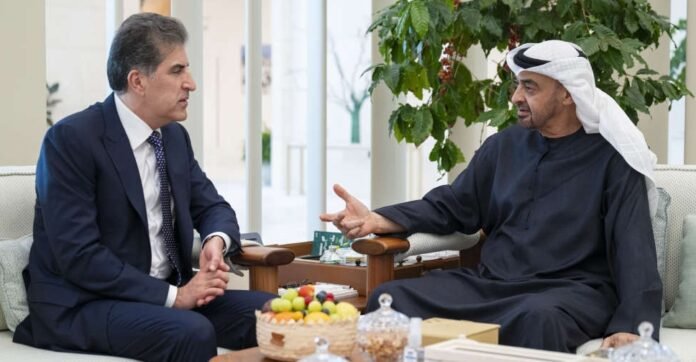
Sheikh Mohamed bin Zayed Al Nahyan, President of the United Arab Emirates, received President Nechirvan Barzani of the Kurdistan Region of Iraq at a high-level meeting in Abu Dhabi, during which the two leaders reviewed the course of bilateral relations and exchanged views on a number of regional issues of common interest.
The meeting examined avenues for expanding cooperation between the UAE and the Kurdistan Region across political, economic and developmental sectors. Both leaders explored prospects for deeper collaboration in investment, trade and development projects, affirming that closer coordination would serve the shared economic and political interests of both sides.
Discussions also addressed current developments in the Middle East and their implications for regional security. The two sides underscored the importance of dialogue and constructive engagement in de-escalating tensions, and stressed that sustained cooperation among regional partners remains essential to safeguarding stability in an increasingly complex environment.
Sheikh Mohamed bin Zayed and President Barzani reaffirmed their mutual commitment to deepening institutional ties and to maintaining regular communication at the highest level, in line with the longstanding relations binding the UAE and the Kurdistan Region. They also reviewed avenues for broadening cooperation across multiple sectors.
The visiting delegation included President Nechirvan Barzani’s son, Idris Nechirvan Barzani, alongside an accompanying delegation, reflecting the significance attached to the visit and to strengthening ties with the UAE.
Observers view the meeting as part of a broader UAE effort to expand its regional partnerships, with economic cooperation continuing to anchor the relationship alongside political coordination and joint development initiatives. Both sides expressed interest in deepening collaboration in these areas.
The meeting concluded with a shared commitment to maintain regular dialogue and to strengthen frameworks of cooperation, reinforcing the importance of long-term engagement in support of regional stability and development.
