
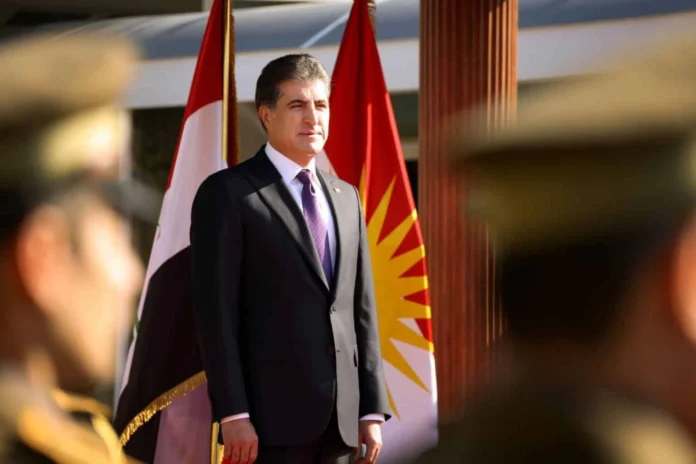
The Kurdistan Region security came under severe threat Saturday when drones targeted President Nechirvan Barzani’s residence in Duhok. Iraqi Prime Minister Mohammed Shia Al-Sudani immediately condemned the attack and called Barzani to reaffirm Baghdad’s full support. Authorities quickly formed a joint federal and regional team to investigate the incident.
Simultaneously, the United Arab Emirates President Mohamed bin Zayed Al Nahyan strongly condemned the strike. He emphasized the UAE’s unwavering support for Iraq and the Kurdistan Region. The UAE highlighted the urgent need to protect civilians and institutions while preserving stability. President Barzani expressed gratitude for the UAE’s support and urged continued efforts to safeguard residents and government facilities.
French President Emmanuel Macron also strongly condemned the drone attack during a call with Barzani. He reaffirmed France’s support for the Kurdistan Region and Iraq. Macron expressed condolences for Peshmerga losses during an Iranian missile strike last week in Erbil’s Soran district, where six fighters died and thirty were injured. Barzani thanked Macron for France’s backing and stressed the need for diplomatic solutions to regional escalations.
The attack did not cause casualties, but it heightened security concerns. Another drone was intercepted near a Peshmerga base in Duhok, highlighting ongoing threats. Local and federal leaders, including Deputy Prime Minister Qubad Talabani, condemned the incident, describing it as a dangerous escalation. Political blocs such as the Kurdistan Democratic Party and Sunni Azm Alliance demanded accountability and warned that such attacks threaten both the Region and Iraq’s overall stability.
Kurdistan leaders have repeatedly stated that the Region remains neutral and will not serve as a launchpad for attacks on neighboring countries. Nevertheless, pro-Iran armed groups aligned with Tehran’s “Axis of Resistance” have launched more than 460 strikes on alleged US targets since February 28. Iraqi officials acknowledge difficulties in curbing these groups due to their military and political influence.
The Kurdistan Region security continues to be a top priority. Baghdad and Erbil are coordinating to strengthen monitoring and response measures. Both governments stress the importance of diplomacy, regional cooperation, and swift justice against perpetrators. International support from the UAE and France underscores the broader commitment to protect stability and peace in northern Iraq.
